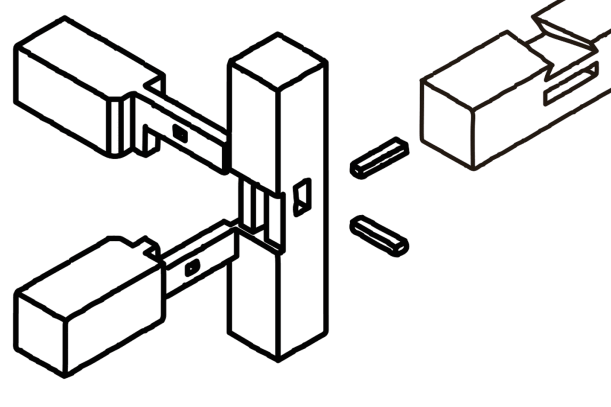
Overview of the Mortise and Tenon Joint
A mortise and tenon joint is a wood joinery method in which a projecting tongue (tenon) on one component fits into a matching cavity (mortise) in another component. It is widely used in furniture, cabinetry, doors, windows, and timber framing because it offers high strength, predictable mechanical behavior, and long-term durability when correctly designed and executed.
The joint can be used with or without glue, and with or without mechanical reinforcement such as pegs or wedges. Its strength comes from direct wood-to-wood bearing, large glue surface area, and favorable load paths aligned with the grain of the wood.
Core Components and Geometric Features
The performance of a mortise and tenon joint largely depends on the proportions, fit, and placement of its main components. Each part plays a distinct mechanical role.
Mortise
The mortise is a rectangular or square hole cut into the receiving member (for example, a table leg or frame stile). Mechanically, the mortise walls provide bearing surfaces for the tenon cheeks and shoulders.
- Orientation: Usually cut with its long dimension parallel to the grain of the mortised member to maintain strength.
- Depth: Chosen to provide enough embedment for shear transfer without excessively weakening the member.
- Wall thickness: Must be sufficient outside the mortise to resist splitting or crushing under load.
Tenon
The tenon is a reduced cross-section tongue formed at the end of the tenoned member (for example, a rail or stretcher). It transmits tension, compression, shear, and bending through bearing contact with the mortise.
Important geometric elements include:
- Cheeks: The wide faces that bear against the mortise walls and provide the primary glue surface.
- Shoulders: The surfaces that seat against the face of the mortised member, controlling alignment and resisting racking and rotation.
- Edges and ends: The perimeter of the tenon that must maintain sufficient thickness to avoid shear failure or splitting.
Shoulders and Bearing Surfaces
Shoulders are critical to the joint’s mechanical stability. When the joint is loaded, shoulders bear against the outside faces of the mortised member, limiting rotation and distributing load over a relatively large area. Even slight gaps at the shoulders can significantly reduce stiffness and increase deflection under load.
Pins, Wedges, and Drawboring
Mechanical reinforcement is often added to increase strength or maintain clamping pressure over time:
Pins or pegs: Typically hardwood dowels passing through both mortise and tenon. They provide resistance to withdrawal and can lock the joint if glue fails. In drawbored joints, peg holes are slightly offset to pull the tenon mechanically into the mortise, preloading the joint in compression.
Wedges: Used with through tenons and some blind tenons. When driven into saw kerfs at the tenon end, wedges expand the tenon inside a flared mortise, increasing friction, bearing pressure, and withdrawal resistance.
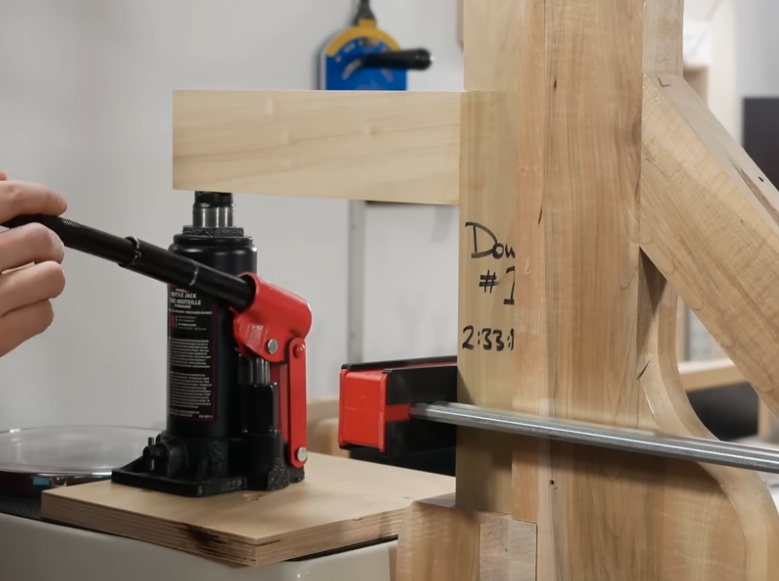
Mechanical Behavior and Load Paths
Understanding how forces flow through mortise and tenon joints is crucial for reliable design. Key load types include tension, compression, shear, bending, and torsion. Different structural configurations (frames, tables, doors, chairs) impose different combinations of these loads.
Compression and Bearing
Compression loads transmit through direct bearing between tenon cheeks and mortise walls, and between shoulders and the outside faces of the mortised member. Properly sized joints distribute compressive stresses over a wide area, keeping local bearing stresses below the crush strength of the wood species.
When joints are drawbored or wedged, pre-compression improves contact between surfaces and reduces micro-movements that can cause wear or looseness over time.
Tension and Withdrawal Resistance
Tension loads try to pull the tenon out of the mortise. Resistance comes from:
- Glue bond on the cheeks and shoulders (where adhesives are used).
- Friction between wood surfaces under clamp or peg pressure.
- Mechanical locking by pins, wedges, or a haunched geometry.
In structural work such as timber framing, joints that must resist significant tension are usually reinforced with pegs, wedges, or metal connectors rather than relying only on adhesive.
Shear and Racking Resistance
Shear forces act along the interface between tenon cheeks and mortise walls. If the tenon is too thin or the mortise walls are too weak, shear failure or splitting can occur. The shoulders act as stops against racking, which is common in table frames, door frames, and chairs subjected to lateral loads.
Racking resistance is strongest when shoulders are continuous on all accessible sides, fit tightly, and are backed by sufficient material thickness in the mortised member.
Bending and Torsion in Framed Structures
In frames, rails and stretchers often carry bending loads. The moment at the joint transfers into the mortised member. The larger the distance between shoulders and the deeper the embedment of the tenon, the better the joint can transfer bending moments without loosening.
Torsional loads (twisting) are resisted mainly by shoulder engagement and side bearing of the tenon. Wide tenons with well-fitted cheeks are better at resisting rotation than narrow, centered tenons.
Dimensional Proportions and Design Parameters
Effective mortise and tenon joints depend on rational proportions that balance strength of the joint with the integrity of the members. The following parameters represent commonly used practice for many furniture-scale joints in medium-density hardwoods. They should be adjusted for heavier structural work, very soft or very hard species, or unusual load conditions.
| Design Parameter | Common Guideline | Notes |
|---|---|---|
| Tenon thickness (front to back) | About 1/3 of member thickness | Often 0.35–0.45 for softwoods; avoids weakening mortised member |
| Tenon length (embedment) | About 4–5 times tenon thickness | Typical range 30–50 mm in furniture; longer for heavy loads |
| Tenon width (shoulder length) | Up to about 2/3 of member width | Leaves material at edges to prevent splitting |
| Minimum mortise wall thickness | At least equal to tenon thickness / 2 | More for highly loaded joints or weak species |
| Shoulder width | 3–6 mm typical on each side | Wider shoulders for frames needing high racking resistance |
| Glue line clearance (fit) | Snug fit, light hand pressure assembly | Allow thin glue film without crushing fibers or starving glue |
These rules of thumb help prevent thin mortise walls, overly slender tenons, and excessive leverage at the joint. When working with large structural timbers, the same ratio approach can be used, but dimensions are scaled up to suit the member sizes and design loads.
Types of Mortise and Tenon Joints and Their Mechanics
Multiple forms of mortise and tenon joints exist to address different structural and construction requirements. Each variant modifies the way forces are transmitted, or the way the joint is assembled and locked.
Through Tenon
In a through tenon, the tenon passes completely through the mortised member and is visible on the far side. This configuration provides:
- Long embedment for strong tension and bending capacity.
- Access for wedges or pins on the exposed end.
- Visual confirmation that the tenon fits correctly.
Through tenons are common in benches, work tables, timber frames, and some visible furniture details. When wedged, the expanded tenon clamps tightly against a flared mortise opening, increasing mechanical locking.
Blind or Stub Tenon
A blind (or stub) tenon stops short of the outside face of the mortised member and is not visible. It is common in cabinet doors, frames, and fine furniture where appearance is important. Mechanical characteristics:
Embedment length is necessarily shorter than a through tenon, so these joints rely more heavily on adhesive and precise fit. Depth is usually limited to avoid showing on the far face, often around 1/2 to 2/3 of the mortised member’s thickness.
Haunched Tenon
A haunched tenon includes a reduced-height portion (haunch) that fills a shallow recess at the edge of the mortise. It is helpful where the mortised member is narrow or where a full-depth mortise would weaken the component, such as at the top rail of a frame near a thin edge.
Mechanically, the haunch:
- Provides additional bearing to resist twisting and racking.
- Allows a wider shoulder without removing too much material from the mortised member.
- Helps keep narrow frame members from cupping or bowing at the joint.
Loose (Floating) Tenon
In a loose tenon configuration, both members have mortises, and a separate, independent tenon piece fits between them. The load path is similar to a traditional tenon, but the joiner cuts only mortises, often using dedicated machines or templates.
Mechanical aspects include:
The tenon material can be chosen for high strength and stability, and its grain aligned to resist tension and shear. The joint still depends on good glue coverage, accurate mortise alignment, and sufficient wall thickness in both members.
Tusk Tenon
A tusk tenon is a type of through tenon secured with a removable wedge or key passing through a slot. It is common in knock-down structures such as trestle tables and some timber frames.
Mechanically, the wedge generates compression that clamps the shoulders tightly against the mortised member. The joint can be disassembled without damage by removing the wedge, while still providing high compression and reasonable racking resistance when assembled.
Material Selection and Wood Behavior
Mortise and tenon joints must accommodate the anisotropic and moisture-dependent behavior of wood. The choice of species and orientation of grain have direct impact on joint strength and longevity.
Wood Species and Strength Properties
Hardwoods with good bending, shear, and compression properties are frequently selected for load-bearing joints. Softwoods can also provide reliable joints if proportions are adjusted to account for lower strength and stiffness.
Important material properties affecting joint performance include:
- Compression parallel and perpendicular to grain (bearing capacity).
- Shear strength parallel to grain (resistance at tenon shoulders and cheeks).
- Modulus of elasticity (influencing deflection and stiffness).
Grain Orientation and Joint Layout
The tenon is generally cut so its length follows the grain of the member, maximizing tensile and bending strength along the joint. Mortises are oriented to leave sufficient long-grain material around the cavity, reducing the risk of splitting.
Cross-grain situations at joints introduce differential swelling and shrinkage, which can open gaps or increase stresses. Designs that concentrate bearing on long-grain surfaces and avoid large cross-grain glue lines tend to perform better over time.
Moisture Movement and Seasonal Change
Wood changes dimension primarily across the grain with variations in moisture content. In a mortise and tenon joint, the mortised member and the tenoned member may move differently, especially if their grain directions are perpendicular.
To accommodate this:
- Tenon width is often limited to a central portion of a wider member, leaving shoulders that can tolerate some movement.
- In wide rails, multiple smaller tenons may be used to reduce cross-grain stress and allow some movement.
- Peg holes are sometimes elongated in the direction of expected movement to reduce splitting risk.
Fit, Tolerances, and Assembly Mechanics
The mechanical effectiveness of a mortise and tenon joint depends heavily on how precisely it is fitted and assembled. Tolerances must account for wood compressibility, adhesive thickness, and assembly method.
Clearances and Tightness of Fit
A good fit allows the tenon to enter the mortise with hand pressure or light hammer taps while maintaining continuous contact on load-bearing surfaces. Excessive tightness can crush fibers, displace glue, and make assembly difficult; excessive looseness reduces bearing area and increases reliance on glue alone.
| Aspect | Typical Target | Mechanical Rationale |
|---|---|---|
| Side clearance at cheeks | Near zero, sliding fit | Maximizes bearing and glue area while allowing assembly |
| End clearance at tenon tip | 0.5–1.0 mm in blind mortises | Allows excess glue to escape; prevents hydraulic pressure |
| Shoulder gap | As close to zero as possible | Maintains squareness, stiffness, and racking resistance |
| Peg hole offset (drawbore) | About 0.5–1.0 mm | Provides clamp force without excessive splitting risk |
Glued vs Mechanical-Only Joints
Adhesives significantly increase joint stiffness and capacity when used with well-fitted surfaces. For interior furniture, modern synthetic glues provide strong bonds on clean, close-fitting cheeks and shoulders. For exterior or structural applications, glue must be selected for durability and compatibility with the wood and service environment.
In some structural and traditional contexts, joints are designed to function primarily through geometry and mechanical reinforcement (pegs, wedges, and drawboring), with glue either omitted or treated as secondary. In those cases, the joint proportions and mechanical locking features must be adequate to carry all expected loads without reliance on adhesive strength.
Assembly Sequencing and Clamping
Assembly order influences how evenly clamp pressure and mechanical locking are applied. For multi-rail frames, the sequence must allow joints to seat fully without binding. Clamping should press shoulders firmly against the mortised member and maintain alignment until the glue cures or pins are driven.
Over-tight clamping that distorts members can lead to internal stresses and misalignment, while insufficient clamping pressure reduces bond quality between tenon cheeks and mortise walls.
Tools, Methods, and Accuracy Considerations
The structural performance of a mortise and tenon joint is directly affected by the accuracy with which its components are cut. Both traditional hand tools and modern machinery can produce high-quality joints if used with appropriate methods and tolerances.
Hand Tools
Typical hand tools include chisels, hand saws, marking gauges, and layout knives. Benefits include precise control of fit and the ability to adapt to varied wood behavior. Challenges include maintaining accuracy over multiple identical joints and achieving consistent tenon thickness and mortise width.
Machines and Jigs
Machines such as mortisers, routers with jigs, and table saws with tenoning fixtures produce repeatable joint geometry. Key considerations are:
- Alignment between mortise and tenon reference faces.
- Control of depth, width, and shoulder location.
- Repeatability for frames with multiple identical joints.
Machinery allows production of multiple joints to tight tolerances, which improves fit consistency and overall structural behavior of the assembly.
Measurement and Quality Control
Accurate layout and measurement are essential. Checking tenon thickness against mortise width, confirming depth, and verifying shoulder squareness reduce the likelihood of cumulative errors across assemblies. Dry fitting before glue-up or final wedging allows defects to be detected while corrections are still practical.
Applications in Furniture and Structural Frames
Mortise and tenon joints are widely used because they provide predictable mechanical performance and long service life. Their behavior, however, must be matched to the specific application and loading environment.
Furniture and Cabinetry
In tables, chairs, cabinets, and doors, joints often face cyclic and dynamic loads combined with humidity changes. Mortise and tenon joints provide:
- High racking resistance in tables and frames due to shoulder engagement.
- Reliable alignment and squareness over time when properly proportioned.
- Ease of repair and re-tightening when pins or wedges are used.
Dimensioning in furniture focuses on achieving adequate stiffness while keeping components visually appropriate and not overly massive.
Timber Framing and Heavy Structures
In timber framing, members are larger and loads are higher, but the mechanical principles remain the same. Joints are sized based on structural calculations, considering compression, tension, shear, and bending, as well as safety factors and building code requirements.
Features such as long through tenons, substantial pegs, and heavy wedges are used to transfer forces safely. Moisture movement over large cross-sections is more significant, so allowances for shrinkage, settlement, and differential movement are integral to the joint design.
Service Conditions and Durability
In exterior or exposed conditions, the joint’s durability depends on species selection, protective finishes, drainage, and ventilation. Water traps and end-grain exposure should be minimized at joint locations. In such environments, mechanical locking and appropriate adhesives are combined to maintain structural performance over time.
Common Issues, Constraints, and Design Considerations
Even when the basic mechanics of mortise and tenon joints are well understood, practical issues can arise in design and construction. Awareness of these constraints helps avoid performance problems.
Over-Thinning the Mortised Member
If the mortise is too wide or too close to an edge, the remaining wall thickness may be insufficient to resist splitting under load or during peg insertion. This is a frequent constraint when joining narrow rails to slender legs or stiles. Proportion rules that maintain adequate wall thickness are critical to prevent failures.
Inadequate Tenon Thickness or Length
Tenons that are undersized relative to the loads they must carry can fail in shear or tension. Short embedment length reduces the available bearing area and increases stresses at the base of the tenon. When design limitations restrict tenon size, additional reinforcement or alternative joint types may be necessary.
Moisture-Induced Gaps and Looseness
Seasonal shrinking and swelling can create gaps at shoulders and cheeks if joints are designed without allowance for wood movement. Over time, cyclic movement can loosen pins and reduce friction, lowering joint stiffness. Designing with appropriate tenon width, grain orientation, and peg hole shapes helps mitigate this effect.
Assembly Difficulty in Complex Frames
In frames with multiple intersecting mortise and tenon joints, the need to assemble several joints simultaneously can complicate construction. Excessively tight fits or slight dimensional errors may prevent full seating of all tenons at once. Planning assembly sequence, using slightly varied fits where appropriate, and providing accessible clamping points are important design considerations.
Summary
Mortise and tenon joints work by combining well-proportioned geometry, controlled fit, and favorable load paths to transfer forces efficiently between wooden members. The mortise provides bearing and support, the tenon transmits tension, compression, and shear, and the shoulders stabilize the joint against racking and rotation. Mechanical aids such as pins, wedges, and drawboring enhance locking and long-term reliability, especially in structural applications.
Careful attention to joint proportions, material properties, grain orientation, moisture behavior, and assembly tolerances yields joints that remain strong and stable over long periods of service. When these technical aspects are properly managed, mortise and tenon joints provide a robust, predictable, and widely applicable solution for both furniture and structural wood construction.