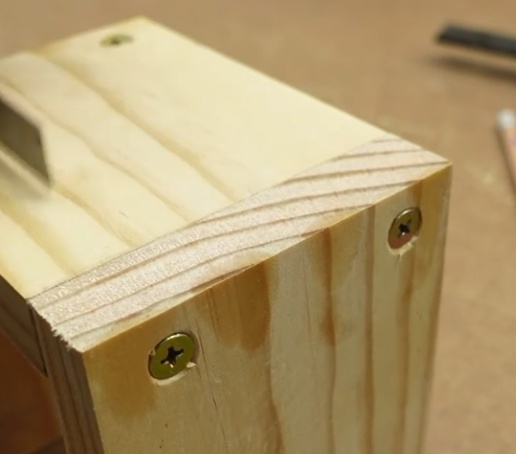
Choosing between wood glue and mechanical fasteners is a core design decision in woodworking, furniture making, cabinetry, and light structural construction. This decision affects strength, stiffness, long‑term durability, appearance, repairability, and cost. This guide explains how each method works, how strong they can be, and how to combine them effectively and safely.
Fundamentals of Load Transfer in Wood Joints
Any joint must transfer loads from one member to another without unacceptable deformation or failure. In wood assemblies, these loads typically include:
- Tension and compression along or across the grain
- Shear parallel to the glue line or fastener plane
- Bending and racking loads on frames and carcasses
Wood glue and mechanical fasteners transfer loads differently:
Wood glue creates a continuous bonded interface between mating surfaces. Loads are distributed over the entire glue area, mainly as shear within the adhesive layer and the adjacent wood fibers. Properly designed, the wood itself often fails before the glue line.
Mechanical fasteners (screws, nails, bolts, dowels) transfer loads through:
- Axial tension or compression in the fastener shank
- Shear at the fastener cross‑section
- Bearing of the fastener against the wood fibers
This difference in load path is central to understanding when each method is appropriate and how to size joints correctly.
How Wood Glue Works at a Technical Level
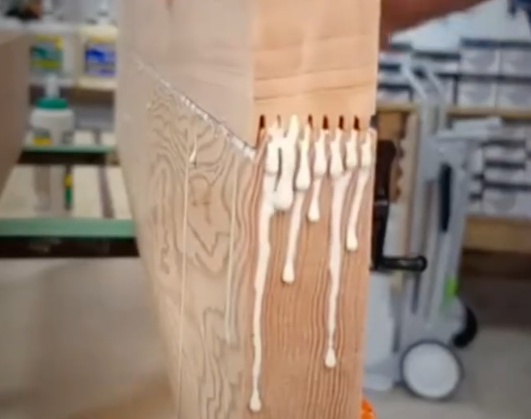
Most modern wood glues are polymer dispersions or reactive adhesives that penetrate wood fibers and form a solid polymer network as they cure. They rely on mechanical interlocking within the wood structure and, for some chemistries, additional chemical bonding.
Chemical Types and Typical Properties
| Adhesive Type | Common Use | Dry Shear Strength (Wood‑Wood) | Water Resistance Level | Typical Open Time (20 °C, 50 % RH) |
|---|---|---|---|---|
| PVA (Type II crosslinked) | Interior & limited exterior furniture, panels | 10–13 MPa | Moderate (ANSI Type II) | 5–10 minutes |
| PUR (one‑component) | Interior/exterior joinery, assemblies with small gaps | 10–12 MPa | High (often exceeds ANSI Type I) | 8–15 minutes |
| Epoxy (structural) | High‑load joints, bonding dissimilar materials | 12–18 MPa | High (depends on formulation) | 20–60 minutes (pot life) |
| Urea‑formaldehyde (UF) | Veneers, curved laminations, panels | 10–15 MPa | Moderate, limited wet cycling | 10–30 minutes (press time dependent) |
Values above are indicative ranges from typical product data; actual performance depends on specific formulation, wood species, surface preparation, and pressing conditions.
Key Performance Factors
Glue joints reach their potential when the following conditions are met:
- Moisture content of wood typically between 6–12 %
- Surface freshly cut or lightly sanded, free of oil, dust, and loose fibers
- Glue spread rates often around 150–200 g/m² (single‑sided, PVA)
- Clamping pressure usually 0.7–1.0 N/mm² for hardwood edge joints (lower for softwood)
- Press or clamp time sufficient for handling strength before demolding
Under these conditions, properly bonded long‑grain to long‑grain joints generally fail in the wood, not in the adhesive, for standard furniture and interior joinery loads.
How Mechanical Fasteners Work in Wood
Mechanical fasteners bite into wood, compress fibers, and rely on friction, embedment, and mechanical interlock to resist withdrawal and shear. Their performance is standardized in multiple design codes and tested under highly defined conditions.
Common Fastener Types
Common mechanical fasteners in wood assemblies include:
- Screws (wood screws, structural screws, self‑tapping)
- Nails (smooth, ring‑shank, screw‑shank)
- Dowels and pins (wooden, metal)
- Bolts and lag screws, often with washers and steel plates
Functionally, they can be categorized as:
Axially loaded fasteners, such as screws in withdrawal resisting tension perpendicular to the joint plane, and shear fasteners, where the main load acts across the fastener shank, such as bolts in double‑shear connections.
Typical Mechanical Properties
Fastener capacities are a function of diameter, embedment length, wood density, and end/edge distances. Representative figures in softwood framing lumber (density around 350–450 kg/m³) for a single fastener might be:
- Withdrawal resistance of a 4 mm wood screw: roughly 0.5–0.9 kN per 25 mm embedment, depending on thread type and pilot hole
- Shear capacity of a 6 mm structural screw: around 2–4 kN in single shear under dry conditions, with specific design values depending on code and safety factors
- Shear capacity of a 10 mm bolt in side‑grain connection: on the order of several kN per bolt, often governed by wood bearing and fastener bending
For structural design, standardized equations account for dowel‑bearing strength, fastener yielding modes, and combined load effects. In furniture and cabinetry, the same principles apply but are often treated empirically through manufacturer data and testing.
Comparing Wood Glue and Fasteners by Load Type
Wood glue and mechanical fasteners respond differently to load directions and magnitudes. Understanding this behavior is crucial when deciding between them or combining them in a joint.
| Aspect | Wood Glue | Mechanical Fasteners |
|---|---|---|
| Shear parallel to joint | Very strong on long‑grain; strength spread over area | Local shear at fastener; capacity depends on diameter and quantity |
| Tension perpendicular to joint plane | Limited; glue line may peel under prying loads | Very effective; screws and bolts can take direct withdrawal and tension |
| Racking and bending | Stiff, continuous connection; good for frames and panels | Can be flexible unless many fasteners are used or plates added |
| Long‑term creep | PVA may creep under sustained load; epoxies have lower creep | Steel fasteners have low creep; wood deformation may govern |
| Performance in cyclic humidity | Dependent on adhesive type and surface prep; some loss under wet/dry cycling | Fasteners maintain mechanical continuity; wood swelling may loosen or tighten them |
| Immediate handling strength | Requires curing time; joint initially weak | Immediate full mechanical engagement at installation |
| Reversibility and repair | Difficult to disassemble without damage | Often reversible; screws and bolts can be removed |
When Wood Glue Alone Is Appropriate
Glued joints without additional mechanical fasteners are suitable when loads, wood configuration, and service conditions align with adhesive capabilities.
Long‑Grain to Long‑Grain Joints
Edge gluing boards, laminating beams, building panel cores, and constructing many classic joinery methods (mortise‑and‑tenon, dowel‑reinforced, finger joints) rely primarily on long‑grain glue bonds. Under correct conditions, these joints can achieve shear strengths similar to or exceeding the base wood.
Applications where glue alone is typically sufficient include:
- Tabletops and panels assembled from edge‑glued boards
- Furniture frames using well‑fitted mortise‑and‑tenon joints
- Cabinet carcasses with glued dados and rabbets
- Curved laminations where the large bonded area provides high stiffness
Conditions Favoring Adhesive‑Only Solutions
Using only wood glue is most appropriate when:
- Joint surfaces have substantial long‑grain area for load transfer
- Service loads are predominantly shear and compression, not peeling
- Joints are protected from liquid water and extreme moisture cycling, or a sufficiently water‑resistant adhesive is selected
- Appearance must be free of visible fasteners
- Components will not be intentionally disassembled
When Mechanical Fasteners Alone Are Appropriate
Mechanical fasteners by themselves can be the primary load‑carrying connection when adhesive use is impractical, unnecessary, or undesirable.
Situations Suited to Fastener‑Only Connections
Typical scenarios include:
- Temporary structures, jigs, and fixtures needing disassembly
- Heavy framing where code‑listed nailed or screwed connections are prescribed
- Outdoor assemblies exposed to weather, where adhesive durability is uncertain or difficult to control on site
- Connections primarily loaded in withdrawal or tension perpendicular to the joint plane, such as hangers, anchors, and supports
In construction, nailed and screwed joints are dimensioned based on design codes providing allowable loads per fastener under specified conditions. This ensures predictable performance when adhesive quality control cannot be guaranteed.
Design Considerations for Fasteners
Important design factors for mechanical fastener‑only connections include:
- Minimum edge and end distances to prevent splitting
- Pre‑drilling in dense hardwoods or near end grain to reduce cracks
- Fastener spacing to avoid cumulative splitting and to distribute loads
- Corrosion resistance appropriate to environment (e.g., galvanized or stainless outdoors)
- Allowance for movement; some connections must permit wood shrinkage and swelling
Combining Wood Glue and Mechanical Fasteners
Many high‑performance wood assemblies use both glue and fasteners. Each component addresses a different aspect of the load and service requirement, often leading to improved overall behavior compared with either method alone.
Complementary Roles
Typical combined strategies include:
- Glue for stiffness and distributed load transfer across the joint surface
- Fasteners for immediate handling strength before adhesive curing
- Fasteners to resist peeling, withdrawal, or eccentric loads that tend to open the joint
- Glue to reduce slip and improve vibration and racking resistance in framed assemblies
Examples:
- Glued and screwed subflooring, where adhesive limits squeaks and increases stiffness while screws resist uplift and concentrated loads
- Cabinet carcasses with glued joints reinforced by screws, where screws act as clamps during curing and provide redundancy
- Laminated beams with bolted connections, where glue bonds laminations and bolts connect members to supports
Interaction Effects and Practical Constraints
When combining glue and fasteners, consider:
- Fasteners must not introduce significant gaps; joints should be brought into full contact before the adhesive sets
- Driving fasteners too early in low‑viscosity glues can squeeze out adhesive and starve the joint; controlled clamping pressure is preferable
- Penetration of fasteners through glue lines should not compromise bond area excessively
- Design assumptions: structural calculations typically treat adhesive and fasteners separately unless tested as a system; capacity is not simply additive without data
Material and Geometry Considerations
Wood species, grain orientation, and product type strongly influence the relative advantage of glue and mechanical fasteners.
Grain Orientation
Key configurations include:
- Long‑grain to long‑grain: optimal for adhesives, high shear strength
- Long‑grain to end‑grain: reduced adhesive strength; glue penetration into end‑grain can reduce effective bond line continuity
- End‑grain to end‑grain: generally unsuitable for glue as a primary load path; mechanical fasteners or specialized joinery are preferred
For end‑grain joints, fasteners or specialized geometries (such as tenons, dowels, or loose tenons) are often necessary to provide mechanical interlock and adequate load path.
Solid Wood vs Engineered Wood Products
Engineered wood materials influence fastener behavior and adhesive bonding:
- Plywood: stable, dimensionally controlled; glue bonds well to veneers, screws and nails hold well in face and edge plies with correct edge distances
- Oriented strand board (OSB): works well with nails and screws for sheathing; adhesive bonding is possible but skin surface and resin content must be considered
- Medium density fiberboard (MDF): good for glue bonding on flat surfaces; screw holding capacity is lower at edges, requiring specific fastener types and pilot holes
- Laminated veneer lumber (LVL) and glulam: structural products where adhesive is integral to manufacturing; field connections typically rely on mechanical fasteners and steel hardware
Service Conditions and Environmental Effects
Service environment heavily affects the long‑term reliability of glued and mechanically fastened joints.
Moisture and Humidity
Wood dimension changes with moisture content, while steel fasteners do not. This can result in:
- Loosening of nails and screws in cyclic swelling and shrinkage
- Stresses in glue lines if movement is restrained and the adhesive is rigid
Adhesive selection should match exposure:
- Interior dry: PVA and UF commonly used
- Damp or occasional wet: crosslinking PVA, polyurethane, or epoxy
- Permanent wet or submerged: epoxies or specialty marine adhesives, often combined with bolts and screws
Fastener selection should address corrosion risks:
- Galvanized or stainless fasteners in outdoor and treated lumber applications
- Appropriate coatings when used with chemically treated or tannin‑rich species
Designing for Movement and Differential Behavior
Wood movement across the grain with humidity changes can impose significant internal stresses. Purely glued large surfaces across grain are vulnerable if movement is restrained, whereas fasteners can allow limited slip.
Movement‑Compatible Strategies
Common strategies include:
- Gluing only in areas where grain directions are compatible and allowing mechanical fasteners or floating joints where differential movement occurs
- Using elongated fastener holes in metal hardware to permit wood movement while maintaining load transfer
- Segmenting large glued assemblies with movement joints so each panel moves independently
This emphasizes that glue is best suited to joints where movement between members is minimal or symmetrical, while fasteners can accommodate limited differential movement when properly detailed.
Installation, Quality Control, and Inspection
Performance of both glued and mechanically fastened joints relies on field execution quality and inspection.
Glue Joint Quality Factors
Consistent adhesive performance depends on:
- Correct adhesive choice for wood species, environment, and load
- Accurate mixing, for multi‑component products, and control of pot life
- Uniform spread with adequate but not excessive application rates
- Correct clamping pressure and duration at appropriate temperature
Visual inspection includes checking for continuous squeeze‑out along edges (for many PVA applications), absence of starved joints, and correct alignment without gaps.
Fastener Installation Quality Factors
Fastener performance is sensitive to:
- Correct diameter, length, and type as specified in design
- Pilot holes where required to avoid splitting and to ensure thread engagement
- Proper driving torque; over‑driving can crush fibers and reduce capacity, while under‑driving leaves components loose
- Correct edge and end distances, embedment depth, and spacing pattern
Inspection typically verifies fastener type, head seating, spacing, and overall alignment of members.
Application‑Specific Guidelines
Different woodworking and construction applications tend to favor specific combinations of glue and mechanical fasteners based on typical load patterns and service conditions.
Furniture and Cabinetry
In interior furniture and cabinetry:
- Primary structural joints (e.g., chair frames, table bases) often use glue‑centric joinery such as mortise‑and‑tenon, reinforced with dowels or loose tenons
- Drawer boxes and carcasses rely on glued dovetails, dados, or rabbet joints for stiff, racking‑resistant connections
- Screws are frequently used to attach hardware, knock‑down fittings, and components designed for assembly and disassembly
Glue predominates for aesthetics and stiffness; screws and other fasteners provide adjustability, reinforce localized stress areas, and enable repairs.
Building Construction
In structural framing and sheathing:
- Nailed or screwed connections dominate, because they are simple, inspectable, and codified
- Adhesive use is common as a supplement, such as subfloor adhesives, to reduce noise and increase stiffness
- Engineered wood products rely on factory‑controlled adhesives internally, with fasteners for field connections
Design usually treats glue as auxiliary in field construction unless specifically tested and detailed, while fasteners carry the code‑recognized structural loads.
Cost, Efficiency, and Practical Considerations
While performance is central, cost and practicality also affect the choice between wood glue and mechanical fasteners.
Material and Labor Aspects
Glue joints require time for application, alignment, clamping, and curing. Fastener‑only joints can be assembled quickly with minimal waiting time, but may require more expensive hardware (e.g., structural screws) and specialized tools.
Key considerations:
- Batch production often favors adhesive bonding with jigs and presses, reducing per‑joint labor
- One‑off or on‑site connections often favor mechanical fasteners because they are less sensitive to environmental conditions and cure times
- Hybrid methods can optimize shop time (gluing) and on‑site assembly (screws and bolts)
Safety and Reliability Considerations
For critical applications, safety margins and failure modes must be predictable. Mechanical fasteners offer visible, countable elements, while adhesive joints rely on process control and surface quality.
Redundancy and Failure Mode
In many assemblies, combining glue and fasteners provides redundancy: if the adhesive bond degrades over time due to unforeseen conditions, fasteners can continue to support the load, and vice versa. For non‑redundant adhesive‑only joints in critical applications, manufacturing controls and testing should verify bond quality.
Summary of Key Selection Principles
Choosing between wood glue and mechanical fasteners is not a simple either‑or decision. The optimal approach is based on load paths, environment, desired stiffness, reversibility, and manufacturing conditions:
- Use wood glue as the primary load‑bearing mechanism where there is adequate long‑grain area, controlled conditions, and need for stiffness and clean appearance
- Use mechanical fasteners where loads include significant tension or withdrawal, where disassembly is required, or where field conditions make adhesive quality control difficult
- Combine both where immediate handling strength, redundancy, and enhanced stiffness are needed, ensuring that joint geometry and detailing allow both mechanisms to function effectively
By analyzing load paths, material properties, and service conditions systematically, designers and builders can select the right balance of wood glue and mechanical fasteners to achieve durable, efficient, and reliable wood assemblies.