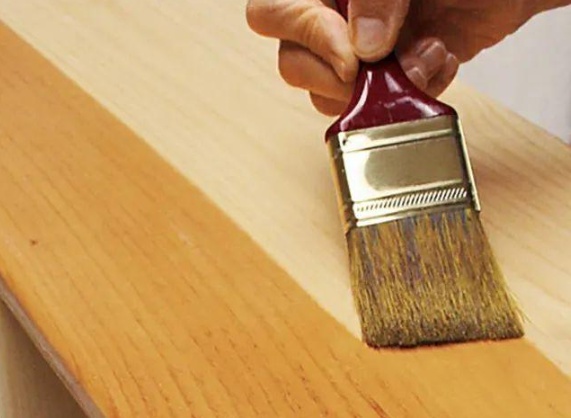
Fundamentals of Wood Surface Treatment
Wood surface treatment is the set of processes applied to wood substrates to protect them from moisture, UV radiation, biological attack, mechanical wear and chemical exposure, while also achieving desired aesthetic and functional properties. It typically combines mechanical preparation (such as sanding), chemical modification (such as preservatives and primers), and the application of film-forming or penetrating finishes.
Effective wood surface treatment depends on the interaction between the substrate characteristics and the selected treatment system. Key substrate parameters include wood species, density, porosity, growth-ring structure, extractive content, and moisture content. Treatment systems must be selected and applied in a way that ensures adhesion, dimensional stability, and long-term performance under the target service conditions.
Wood surface treatment is used in applications including furniture, flooring, joinery, cladding, windows, doors, decking, structural elements, and industrially coated components. Requirements vary widely depending on whether the wood is used indoors or outdoors, in dry or humid conditions, in contact with the ground or water, and whether it will be subject to heavy wear or chemical exposure.
Characteristics of Wood Relevant to Surface Treatment
Understanding the physical and anatomical properties of wood is essential for choosing and applying surface treatments correctly. Wood is anisotropic and hygroscopic, which makes its behavior under coatings different from metals or plastics.
Wood Species and Density
Softwoods (such as pine, spruce and fir) and hardwoods (such as oak, beech and ash) differ significantly in density, porosity and extractives content. These parameters influence penetration depth, adhesion and coating consumption.
- Low-density softwoods: more absorbent, higher finish uptake, may require additional sealing to prevent uneven absorption.
- High-density hardwoods: less absorbent, may need special primers or thinner first coats to ensure adequate wetting and adhesion.
- Oily or resinous woods (teak, ipe, some pines): surface extractives can interfere with coating adhesion and drying, requiring careful cleaning and sometimes special primer systems.
Moisture Content and Dimensional Movement
Wood continuously exchanges moisture with the environment until it reaches equilibrium moisture content (EMC) corresponding to ambient temperature and relative humidity. Excessive wood moisture content at the time of finishing can lead to poor adhesion, blistering and peeling.
For most interior applications, wood moisture content is typically targeted in the range of 6–10% before finishing. For exterior applications and construction elements, 12–16% is common, depending on climate and use. Coatings must be sufficiently elastic and water-vapor permeable to accommodate dimensional changes resulting from humidity fluctuations.
Surface Texture and Porosity
Surface texture, including roughness from machining and the presence of earlywood and latewood bands, affects the visual appearance and behavior of finishes. Coarse surfaces tend to absorb more finish and can show more pronounced grain after staining. Planed or finely sanded surfaces provide more uniform absorption but may reduce stain penetration depth.
Open-pore species such as oak and ash often require grain filling if a very smooth, closed-pore finish is desired. Fine-pore species do not generally require such filling, but may still need pore sealing to control absorption and improve film build.
Surface Preparation Techniques
Surface preparation is critical for achieving durable and visually uniform wood surface treatments. It directly influences adhesion, coating uniformity and the absence of defects such as raised grain or visible machining marks.
Cleaning and Degreasing
Before sanding and coating, woodworking dust, oils, fingerprints, and extractives must be removed. Typical procedures include vacuum cleaning, compressed-air blow-off (with filtered, dry air), and wiping with suitable cleaning agents.
For oily hardwoods and resinous softwoods, solvents or special cleaning solutions are often used to dissolve surface extractives. After solvent use, sufficient flash-off time is required to prevent solvent entrapment under the coating layer.
Sanding Procedures and Parameters
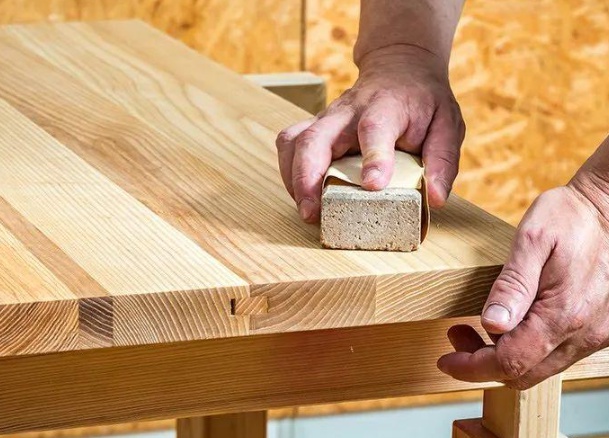
Sanding equalizes surface roughness, removes machining marks and improves mechanical anchorage for subsequent coatings. Sanding parameters are selected with respect to the intended finish type.
- Grit sequence: typical sequences for furniture and joinery are P80–P120–P150–P180 for raw wood; finer grits (P220–P320) are used for intercoat sanding between finish layers.
- Sanding direction: sanding generally follows the grain direction to reduce visible scratches, especially for transparent finishes.
- Sanding equipment: belt sanders, orbital sanders, wide-belt sanding machines and brush sanders are used depending on component size and production scale.
Excessively coarse sanding can lead to high absorption and non-uniform stain appearance. Overly fine sanding can reduce stain penetration and may cause adhesion issues for certain coatings, especially on dense hardwoods.
Dust Removal and Surface Inspection
After sanding, all dust must be removed from the surface and adjacent structures before coating. Residual sanding dust can cause surface defects, inclusions, and weakened adhesion. Methods include vacuum extraction, tack cloths, and ionizing air systems for static charge reduction.
Visual and tactile inspection of the substrate is necessary to identify defects such as burn marks, torn grain, glue squeeze-out, cracks, knots, and resin pockets. Such areas often require localized re-sanding, cleaning, or, in the case of knots and resin pockets, sealing or removing the defective area if necessary.
Wood Pretreatments and Primers
Pretreatments and primers prepare the wood surface for subsequent layers by improving adhesion, equalizing absorption, providing initial protection against biological attack, and preventing discoloration or bleeding from extractives.
Wood Preservatives
Wood preservatives are applied where there is a risk of fungal decay, blue stain, insects, or termites, especially in exterior applications, ground contact or high-humidity environments. Preservatives can be integrated into industrial impregnation processes (pressure-impregnated wood) or applied by brush, spray or dipping.
Common preservative types include water-based and solvent-based formulations, often containing biocidal active substances. Treatment depth and retention depend on wood species, moisture content, and process parameters (such as vacuum-pressure cycles in industrial treatment).
Primers and Sealers
Primers and sealers create a suitable interface between raw wood and subsequent coatings. Functions include adhesion promotion, pore sealing, equalization of absorption, and blocking of extractives.
Primer types include:
- Adhesion primers: improve bonding of subsequent coats on difficult substrates or oily woods.
- Stain-blocking primers: reduce discoloration from water-soluble extractives, tannins, and resins, particularly important on species like oak, cedar and certain pines.
- Sealers: reduce porosity to improve film build and gloss uniformity, often used as the first layer in multi-coat systems for furniture and flooring.
Application quantities and solids content of primers are selected according to substrate absorbency and required barrier effect. Insufficient film build can lead to uneven absorption and color differences; excessive film build may reduce adhesion or lead to cracking during service.
Wood Staining and Coloring Systems
Staining and coloring modify the appearance of wood while maintaining or adjusting the visibility of the grain. Coloring systems must be compatible with the chosen topcoat chemistry and application method.
Types of Wood Stains
Common stain categories include:
Water-based stains: These use water as the main solvent. They have low VOC content and provide good color clarity. Water-based stains tend to raise the grain and may require light de-nibbing after drying. They provide good penetration on many species and allow long open time for wiping.
Solvent-based stains: These utilize organic solvents for rapid drying and reduced grain raising. They offer good penetration and uniformity, especially on dense or difficult species. Ventilation, explosion protection and solvent-emission considerations are important in industrial use.
Oil-based stains: Based on drying oils and pigments, they provide rich color and relatively long working time. They often combine staining and partial surface sealing. Penetration is typically deep, contributing to good color durability, especially in exterior applications.
Reactive stains: These contain components that chemically react with constituents of the wood (such as tannins) to create colors. They are often used on oak and other tannin-rich species to achieve special effects and aged appearances. Application and neutralization steps must be precisely controlled.
Stain Application Techniques
Stains can be applied by brush, sponge, cloth, spray, roller, curtain coater, or automated spraying machines. Application parameters such as quantity, spreading time, wiping technique and drying conditions determine color uniformity and depth.
For many stain systems, excess material is wiped or brushed off to avoid lap marks and stripe formation. Vertical surfaces are typically stained from bottom to top to reduce runs. Color samples and test areas are used to verify color and absorption before treating the entire surface.
In industrial lines, stain application may be followed by intermediate drying, forced-air or infrared drying, and mechanical scuffing before application of clear or pigmented topcoats.
Clear and Pigmented Coating Systems
Coating systems form protective layers on wood surfaces, influencing appearance, durability and maintenance intervals. They can be transparent, translucent or opaque, and may be film-forming or penetrating. Selection depends on the application (interior vs exterior), mechanical loads, UV exposure and required appearance.
Water-Based Coatings
Water-based coatings are widely used for both interior and exterior applications. They reduce solvent emissions and can be formulated for high mechanical and chemical resistance. Water-based acrylics and polyurethane dispersions are common.
Key characteristics include relatively fast drying, good flexibility, and options for low gloss to high gloss finishes. Sensitivity to low temperatures and high humidity during drying must be considered. Substrate preparation and primer selection are important to prevent grain raising and ensure smooth finishes.
Solvent-Based and High-Solid Coatings
Solvent-based coatings, including alkyd, polyurethane and nitrocellulose systems, provide very good flow and leveling and often shorter drying times at ambient conditions. High-solid formulations reduce the proportion of solvent by increasing solids content, thereby reducing VOC emission at equal film builds.
Nitrocellulose coatings are known for fast drying and easy repair, often used on furniture. Two-component polyurethane coatings provide high chemical and mechanical resistance and are used on surfaces subject to high stress, such as tables and shop fittings.
Oils, Waxes and Oil-Wax Systems
Oils and waxes penetrate the upper wood layers and provide a more natural look and feel with open pores. They are often based on plant oils such as linseed, tung, or modified vegetable oils. Waxes can be used in combination with oils or as separate products.
Oil and oil-wax systems preserve the tactile properties of wood and are used for flooring, furniture and interior elements. They require regular maintenance and renovation but allow localized repair without complete stripping of the surface. Application is usually by brush, roller, or pad, followed by removal of excess material and polishing.
Varnishes and Lacquers
Varnishes and lacquers are film-forming systems that can be clear or pigmented. They are used when higher mechanical protection or specific gloss levels are required. Depending on the binding agent, they may be one-component or two-component systems.
Parameters such as solids content, viscosity, crosslinking mechanism, and film thickness determine resistance to abrasion, chemicals and moisture. Multiple coats with intermediate sanding are typically used to achieve uniform build and smoothness, especially for high-gloss finishes.
Exterior Wood Surface Treatment
Exterior wood is exposed to sunlight, precipitation, temperature fluctuations and biological attack. Surface treatments must therefore provide UV protection, water repellency, and adequate water-vapor permeability to prevent moisture accumulation in the wood.
UV Protection and Weather Resistance
UV radiation breaks down lignin in the upper wood layers, leading to graying and surface erosion. Pigments and UV absorbers in coatings reduce this degradation. Transparent coatings for exterior use typically contain light-stable pigments or nanoparticle UV absorbers to improve durability.
Film-forming coatings for exterior applications, such as window profiles and cladding, are designed for elasticity, crack resistance and controlled water vapor diffusion. Too rigid coatings can crack as wood moves; too impermeable coatings can trap moisture and lead to premature failure.
Decking, Facades and Outdoor Furniture
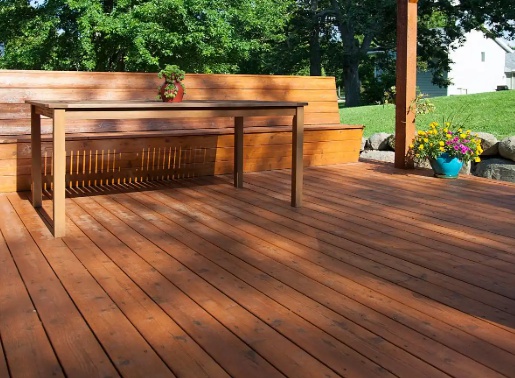
Decking and outdoor furniture are subject to mechanical wear, standing water and soiling. Penetrating oils and oil-based stains are often used because they are easy to renew and do not tend to flake. Periodic cleaning and re-oiling is required, depending on exposure and use.
For facades and cladding, translucent and opaque coating systems are used. Translucent systems preserve the wood appearance, while opaque paints provide stronger UV protection and longer maintenance intervals. Details such as end-grain sealing, joint design, and dimensional stability of the construction are critical for the performance of any coating system.
Interior Wood Surface Treatment
Interior wood surfaces are less exposed to weather but can face mechanical, chemical and thermal stresses depending on their use. Appearance and haptic quality often play a key role, especially for furniture and interior design elements.
Furniture and Joinery
Furniture coatings must combine aesthetic requirements with resistance to everyday use. Parameters such as scratch resistance, resistance to household chemicals, and heat resistance are considered. Systems used include water-based and solvent-based lacquers, two-component polyurethane coatings, and oil-wax systems.
Joinery elements such as interior doors, moldings and stair components are often coated with clear or pigmented coatings with medium film builds. The coating system must be matched to the substrate, especially when different wood species or engineered wood products are combined in one assembly.
Flooring and Stairs
Wood flooring requires high abrasion resistance and durability under foot traffic. Coating systems include multi-layer lacquer systems (often two-component polyurethane or UV-cured coatings) and hardwax oil systems.
Lacquered floors provide a continuous film with high wear resistance; repair of localized damage is more demanding. Oil and hardwax oil systems allow local renovation and preserve a natural feel but require regular care treatments. Slip resistance, gloss level and chemical resistance are defined according to applicable standards and building requirements.
Application Methods and Equipment
Choice of application method affects film build, uniformity, productivity and material consumption. Parameters such as viscosity, pot life, and drying time must be matched to the chosen method.
Manual Application Methods
Brush and roller application are common for on-site work, small series and renovation. They are flexible and allow good control in complex geometries such as windows and stair railings. Careful brush selection and correct working techniques help avoid brush marks and runs.
Cloth or pad application is typical for oils, waxes and certain stains. The operator distributes the product, works it into the surface and removes excess material. The pressure, speed and number of passes influence penetration and uniformity.
Spray Application Systems
Spray application is widely used in industrial and workshop environments. Systems include conventional air spray, airless, air-assisted airless and high-volume low-pressure (HVLP) guns. Automated spray lines with reciprocating or robot sprayers increase coating consistency and throughput.
Spray parameters include atomizing pressure, nozzle size, gun distance, overlap and feed speed. Correct settings minimize overspray, ensure uniform film thickness and avoid defects such as orange peel or sagging. Adequate extraction, filtration and personal protection are mandatory.
Industrial Coating Lines
In industrial production, wood components are often finished on automated lines combining cleaning, sanding, spraying, flow coating, curtain coating, drying and stacking. Conveyor systems transport parts through individual stations with defined process parameters.
Flow coaters and curtain coaters deliver controlled film builds on molding profiles, frames and panels. UV-curing technology enables high line speeds with rapid property development, particularly for flooring and furniture panels. Process control includes monitoring of coating viscosity, film thickness, curing energy and line speed.
Performance Parameters and Testing
Wood surface treatments are evaluated by standardized tests that measure protective performance, durability and appearance. Specifications may refer to regional or international standards and to customer-specific requirements.
| Parameter | Description | Typical Considerations |
|---|---|---|
| Adhesion | Bond strength between coating and wood substrate | Cross-cut tests, pull-off tests, influenced by preparation, primer, moisture |
| Abrasion resistance | Resistance to wear from mechanical action | Important for floors, stairs, tabletops; tested with standardized abrasion testers |
| Chemical resistance | Resistance to household chemicals, cleaners, liquids | Relevant for furniture and worktops; evaluated with contact or spot tests |
| Water resistance | Resistance to liquid water and high humidity | Especially important for kitchens, bathrooms, exterior elements |
| UV and weather resistance | Color and gloss stability under light and weather exposure | Assessed by accelerated weathering or outdoor exposure tests |
| Gloss level | Surface reflection characteristics | Defined as matt, satin, semi-gloss or high gloss, measured by glossmeters |
| Elasticity | Ability to accommodate wood movement without cracking | Important for exterior and large components subject to humidity changes |
Defects, Issues and Considerations in Wood Surface Treatment
Defects and issues often arise from mismatched materials, insufficient preparation, incorrect application parameters or unfavorable environmental conditions. Recognizing typical defect patterns and their causes allows targeted corrections and prevention.
Common Surface Defects
Typical defects include:
- Blistering and peeling: often linked to high wood moisture content, trapped solvents or poor adhesion due to contamination or incompatible layers.
- Cracking and flaking: caused by insufficient elasticity of the coating relative to wood movement, excessive film thickness or sharp edges without rounding.
- Uneven color and blotching: caused by irregular absorption, differences between earlywood and latewood, or inadequate sealing prior to staining.
- Runs and sags: result from excessive application quantity, low viscosity, or incorrect spray settings.
- Orange peel: occurs when flow and leveling are inadequate, often due to high viscosity, low wet film thickness, or unsuitable application conditions.
Environmental and Process Conditions
Temperature, relative humidity, air movement and dust load in the finishing area significantly influence the outcome. Low temperatures slow drying and can prevent proper crosslinking; high humidity can cause blushing in some solvent-based systems and longer drying times for water-based coatings.
Adequate dust extraction, clean air supply and filtered airflows reduce inclusions and surface defects. Process conditions must be kept within specified ranges for the chosen system, including minimum and maximum substrate and air temperatures, relative humidity and air velocity.
Substrate and Construction Details
Edge radii, joints, end-grain areas and connections between components are critical zones. Sharp edges receive thin coating films and are prone to early failure. End grain absorbs large quantities of moisture and must be carefully sealed.
Construction details such as water-draining profiles, sufficient ventilation gaps and avoidance of water traps greatly influence the effectiveness of any surface treatment in exterior applications. Mechanical fastening systems should be designed to minimize damage to the coating and prevent moisture ingress at fastener locations.
Maintenance, Repair and Renovation
Wood surfaces, especially in exterior or high-wear applications, require periodic maintenance to sustain their protective and aesthetic properties. Maintenance intervals depend on exposure, coating system and substrate.
Cleaning and Regular Maintenance
Regular cleaning removes dirt, microorganisms and deposits that can retain moisture or promote degradation. Mild cleaners that do not attack the coating are used, followed by thorough rinsing and drying. Surfaces treated with oils or oil-wax systems are refreshed with compatible care products according to manufacturer recommendations.
Local Repair and Partial Renovation
Local damage such as scratches, small dents or impaired areas can often be repaired without full stripping. Methods include localized sanding, filling, and reapplication of stain and clear coats. Oil-treated wood is particularly suitable for localized repair, as new oil can be blended into the existing surface after cleaning and light sanding.
Complete Renovation of Coating Systems
When coatings have extensively failed or when a change of color or system is desired, complete renovation may be necessary. This usually involves thorough cleaning, chemical or mechanical stripping of old coatings, surface repair, and reapplication of primers, intermediate coats and topcoats.
In exterior applications such as facades or windows, renovation cycles are influenced by orientation, shading, climatic conditions and design details. Careful assessment of the substrate condition and residual film is essential before choosing between partial and full renovation.
Selection of Wood Surface Treatment Systems
Selection of suitable wood surface treatment systems is based on substrate type, use environment, desired appearance and maintenance capability. A systematic approach helps align technical requirements with practical constraints.
| Application | Typical System | Main Requirements |
|---|---|---|
| Interior furniture | Water-based or solvent-based lacquer, 2–3 coats over primer | Good chemical resistance, pleasant feel, defined gloss level |
| Wood flooring | 2K polyurethane lacquer or hardwax oil | High abrasion resistance, easy cleaning, slip resistance |
| Exterior windows and doors | Elastic water-based coating system with primer, intermediate and topcoat | Weather resistance, UV protection, dimensional movement accommodation |
| Decking | Penetrating exterior oil or oil-based stain | Water repellency, easy renewal, slip resistance |
| Cladding and facades | Translucent or opaque exterior coating system | UV resistance, water-vapor permeability, long maintenance intervals |
In all cases, technical data sheets and processing instructions for the selected products should be followed for substrate preparation, application conditions, minimum and maximum film builds, drying times and maintenance recommendations.
Conclusion
Wood surface treatment is a multi-step, technically demanding process that must take into account substrate characteristics, environmental conditions, coating chemistry and application technology. Through systematic surface preparation, careful selection of pretreatments, stains and coating systems, and controlled application parameters, wood surfaces can achieve long-lasting protection and appearance for both interior and exterior applications.
Attention to detailed aspects such as moisture content, edge rounding, end-grain sealing, and maintenance planning substantially increases the service life and performance of treated wood components. Consistent quality control and adherence to product-specific guidelines complete a robust approach to professional wood surface treatment.