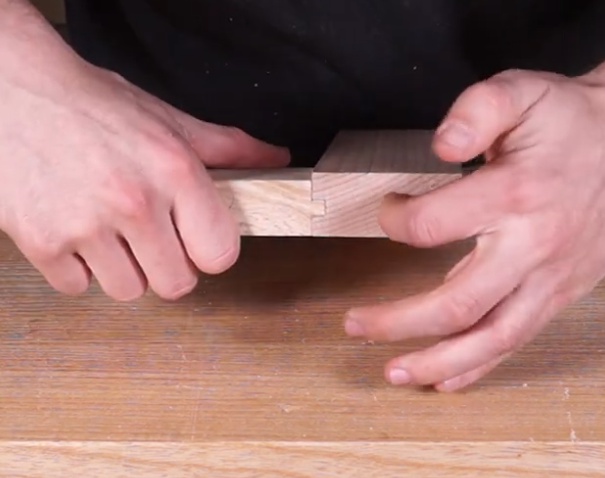
Mortise and tenon joints have been used for thousands of years in furniture, joinery, and heavy timber structures. When properly designed, cut, and fitted, these joints can carry high loads and resist racking without any nails or screws. The effectiveness comes from geometry, precision, and wood behavior, not from metal fasteners.
Fundamental Mechanics of the Mortise and Tenon Joint
A mortise and tenon joint is a shaped projection (tenon) fitting into a matching cavity (mortise). The mechanical performance depends on how these two parts share and transfer load.
Load Transfer and Bearing Surfaces
When the joint is loaded, forces are transferred through direct bearing of wood surfaces:
- The cheeks of the tenon bear against the long walls of the mortise in shear and compression.
- Shoulders of the tenon bear against the face of the mortised member, distributing load and resisting racking.
- Glue, if present, bonds all mating surfaces into a single composite unit.
This arrangement provides a long-grain-to-long-grain bond area and wide bearing surfaces. Compared with screws or nails that concentrate stress around small points, the mortise and tenon spreads load and reduces stress concentrations.
Resistance to Common Types of Forces
The joint can resist several key actions without metal fasteners:
- Tension along the tenon’s length: The tenon shoulders act as stops, and drawbored or wedged variants mechanically lock the tenon in place.
- Shear parallel to the joint faces: Large cheek area provides high shear capacity.
- Bending and racking loads: Shoulders and the depth of the tenon help maintain alignment and resist deformation.
Because of this multipath load transfer, a well-executed mortise and tenon can reach strengths exceeding many screw‑based joints of similar size.
Key Design Parameters That Make Fasteners Unnecessary
Mortise and tenon performance is largely determined by geometric proportions. Correct sizing allows the joint to be strong without additional metal reinforcement.
Tenon Thickness and Width
Tenon thickness is typically a fraction of the member thickness. A common rule:
- Tenon thickness ≈ 1/3 the thickness of the rail or member.
- Minimum practical thickness for many hardwood furniture applications: 6–8 mm (about 1/4–5/16 in).
Tenon width is usually as wide as practical while leaving sufficient surrounding wood in the mortised member. Excessive width can weaken the mortise walls, especially near the edges of the piece.
Tenon Length and Penetration
Tenon length determines lever arm and bearing area:
- Common guideline: tenon length between 1/2 and 2/3 of the mortised member’s width for blind mortises.
- For through tenons, the tenon passes completely through and may protrude slightly for wedging.
Short tenons reduce strength and increase dependence on glue. Adequate depth ensures that the joint’s mechanical engagement alone can carry substantial load.
Shoulder Design and Bearing
Shoulders are critical in joints that must resist twisting and racking. Typical practice includes:
- Continuous shoulders across the full face of the jointed piece.
- Secondary shoulders on adjacent faces for multi-axis restraint when needed.
The shoulders form a broad bearing surface, controlling alignment and distributing load along the face of the receiving member. This improves rigidity without any screws.
Fit Tolerance and Friction
The fit between mortise and tenon must be carefully controlled:
- Too tight: risk of splitting during assembly and difficulty fitting glue.
- Too loose: reduced bearing area and possible joint slop or racking.
Many practitioners aim for a sliding fit that can be assembled by hand pressure or gentle mallet taps. The resulting friction plus glue provides a secure union without fasteners.
Wood Behavior and Why It Favors Mortise and Tenon Joints
Wood is anisotropic and moves differently in different directions. Mortise and tenon geometry can accommodate these behaviors without relying on screws or nails.
Long-Grain Bonding Area
Adhesive joints are strongest in long-grain-to-long-grain contact. Mortise and tenon joints maximize this surface:
- Tenon cheeks and mortise walls are oriented along the grain, offering large bonded areas.
- Adhesive strength in such conditions can easily exceed the bending strength of the surrounding wood.
Nails and screws primarily anchor via withdrawal resistance and limited bearing around threads or shanks, which often involve cross grain and smaller contact areas.
Wood Movement Across the Joint
Wood expands and contracts more across the grain than along it. Mortise and tenon joints can be proportioned so that:
- Movement is taken up mainly in the width of the tenon and mortise walls.
- Shoulders maintain alignment while allowing controlled micro-movement.
When designed with proper clearances and orientation, movement does not break the joint. Metal fasteners can locally restrain wood movement and introduce splitting risk; a properly sized mortise and tenon can avoid this problem.
Variants That Lock the Joint Without Nails or Screws
Several traditional configurations mechanically secure mortise and tenon joints so thoroughly that additional fasteners are unnecessary, even without adhesives.
| Variant Type | Key Feature | Main Benefits | Typical Uses |
|---|---|---|---|
| Plain mortise and tenon | Straight tenon, matching mortise | Simple, strong when glued and well‑fitted | Furniture rails, frames, doors |
| Through tenon | Tenon passes fully through the mortised member | Greater bearing area, visual confirmation of fit | Benches, tables, frames, timber elements |
| Wedged through tenon | Tenon end is slotted; wedges spread it against mortise walls | Mechanical lock; maintains tension without screws | Chairs, tables, knock‑down assemblies |
| Drawbore tenon | Peg holes offset to draw the tenon into the mortise | Self‑clamping joint, strong without glue or screws | Timber frames, doors, structural joinery |
| Haunched tenon | Short haunch fills shallow mortise extension near edges | Reduces twisting, supports thin edge sections | Frame-and-panel doors, window frames |
Wedged Through Tenons
In a wedged through tenon:
- The tenon protrudes beyond the face of the mortised member.
- Saw kerfs in the tenon end create flexible tongues.
- Tapered hardwood wedges are driven into the kerfs after assembly.
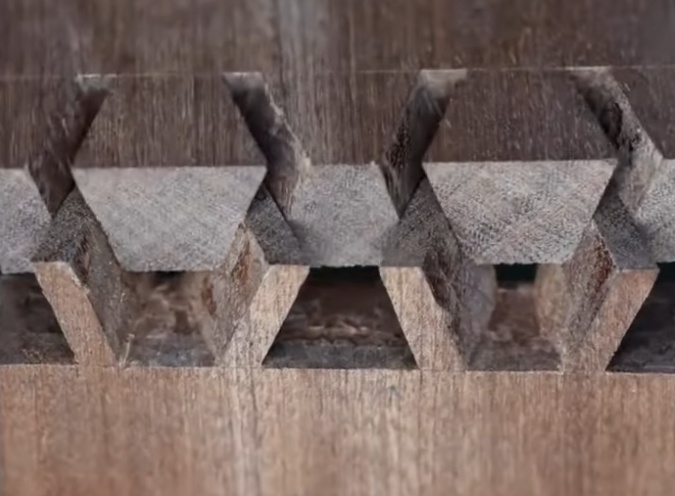
Driving the wedges flares the tenon, creating a dovetail-like mechanical lock. Even if adhesive fails, the geometry alone prevents withdrawal, making nails or screws redundant.
Drawbore Mortise and Tenon
Drawboring uses wooden pins (pegs) driven through offset holes:
- The hole through the tenon is drilled slightly nearer the shoulders than the corresponding hole in the mortise.
- When the peg is driven, the misalignment pulls the tenon shoulder tightly against the mortised member.
This “pre-tensioned” condition keeps the joint tight over time. Drawbored joints can function without glue and still remain structurally secure without metal fasteners.
Applications Where Nails or Screws Are Typically Not Needed
Mortise and tenon joinery is used in both fine woodworking and structural applications. In many of these, properly executed joints make metal fasteners optional.
Furniture and Cabinetmaking
In furniture, mortise and tenon joints are often used for:
- Chair and table legs to rails connections.
- Face frames on cabinets.
- Bed frames and bench stretchers.
When tenons are proportioned correctly and glued with modern adhesives, the wood often fails before the joint does. Additional screws or nails typically do not increase ultimate strength and may simply complicate repair work.
Interior Joinery and Architectural Woodwork
Mortise and tenon joints are standard in:
- Frame-and-panel doors and cabinet doors.
- Window sash construction.
- Stair components and interior frames.
In these applications, joints are usually loaded by racking and cyclic use rather than high structural loads. Correctly fitted tenons, sometimes combined with haunches and shoulders, resist these forces without nails or screws.
Timber Framing and Structural Woodwork
Traditional timber frames rely heavily on large-scale mortise and tenon joints. Common characteristics include:
- Substantial tenon dimensions relative to member size (often 1/3 thickness and significant length).
- Drawbored pegs, sometimes combined with housing (recesses) for beams.
These frames can carry roof and floor loads for decades or centuries without metal bolts or screws. Wooden pegs are used, but they function as integral components of the joint rather than conventional fasteners, and the geometry of the mortise and tenon remains the primary load path.
Comparative Performance: Mortise and Tenon vs Screwed Joints
In many woodworking scenarios, mortise and tenon joints outperform screw-based joints, especially under racking and long-term use.
| Aspect | Mortise and Tenon | Screws / Nails |
|---|---|---|
| Load distribution | Broad surfaces, long-grain bearing, distributed stress | Concentrated around shank or threads, localized stress |
| Resistance to racking | Shoulders and depth give high racking resistance | Often dependent on multiple fasteners or brackets |
| Durability under cyclic load | Less prone to loosening when well-fitted and glued | Fasteners can loosen, especially in softwoods or end grain |
| Wood movement accommodation | Can be proportioned to allow controlled movement | Rigidly restrains movement locally, risk of splitting |
| Repair and maintenance | Parts can be disassembled in some designs; failures are visible at joints | Hidden metal, possible corrosion, damaged threads on disassembly |
Practical Considerations and Common Difficulties
Even though mortise and tenon joints can function without nails or screws, their effectiveness depends on the craft and design. Certain issues arise regularly in practice.
Accuracy of Layout and Cutting
Joint performance declines as inaccuracies increase. Typical problems include:
- Out-of-square shoulders, leading to poor bearing and misalignment.
- Inconsistent tenon thickness causing loose or overly tight areas.
- Mortises that are not parallel or straight through their depth.
Use of accurate marking tools, consistent reference faces, and incremental test fitting reduces these issues and makes the joint reliable without metal fasteners.
Adhesive Selection and Application
While some variants can be used without glue, many furniture joints rely on adhesive. Considerations include:
- Open time sufficient to assemble multiple joints.
- Strength in long-grain bonding and suitable creep resistance for loaded joints.
- Even glue spread on all bearing surfaces without starving or saturating the joint.
With appropriate adhesive and controlled clamping pressure, the bond can exceed the strength of wood itself, eliminating any need for screws or nails to supplement the joint.
Material Selection and Grain Orientation
The joint’s strength is also influenced by the species and grain orientation:
- Dense hardwoods provide high bearing strength on cheeks and shoulders.
- Straight, defect-free grain in the tenon reduces weakness at the root.
- Sufficient distance between mortise walls and edges avoids splitting.
When these factors are properly handled, the inherent strength of wood supports the mortise and tenon joint without metal reinforcement.
Guidelines for Designing Mortise and Tenon Joints Without Fasteners
For joints that must safely function without nails or screws, the following guidelines are commonly applied in practice:
- Tenon thickness around one third of the member thickness, with enough margin to avoid weakening the mortised piece.
- Tenon length sufficient to provide bearing area and leverage, often 1/2 to 2/3 of the mortised member’s width for blind joints and through the member for through joints.
- Full, clean shoulders to ensure good bearing and alignment.
- Accurate, slightly snug fit, assembled with hand pressure or light mallet taps.
- Use of drawbored pegs or wedges where long-term mechanical locking is desired, especially in structural or highly stressed joints.
Following these principles allows mortise and tenon joints to perform as primary structural connections, with no dependence on nails or screws for strength or durability.