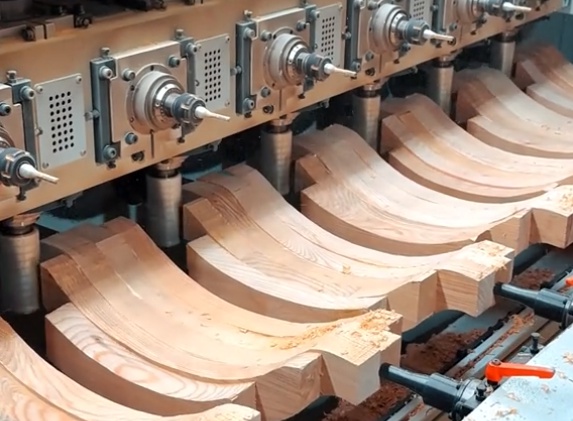
This guide presents a systematic overview of key wood processing types used in industrial and professional woodworking: sawing, planing, milling, sanding, joining, gluing, drying, coating, preservation, fire retardant treatment, CNC engraving, and mortise and tenon joinery. For each process, it explains principles, typical equipment, practical parameters, quality control points, and common constraints.
Sawing: Primary Breakdown and Dimensioning
Sawing is the primary mechanical process that converts logs and lumber into specified dimensions. It determines material yield, fiber orientation, and downstream machining behavior.
Sawing Principles and Cutting Geometry
Sawing removes material with a toothed cutting edge. Critical geometric parameters include:
- Tooth pitch: distance between adjacent teeth, affecting feed speed and surface roughness.
- Rake angle: angle between tooth face and cutting direction, influencing cutting force and chip formation.
- Gullet volume: space between teeth, controlling chip evacuation and heat accumulation.
Proper selection depends on wood species, moisture content, and thickness. Hardwoods and dense species usually require smaller tooth pitch and different rake angles than softwoods.
Main Sawing Methods
Common sawing methods used in sawmills and secondary processing include:
- Band sawing: narrow kerf (typically 1.2–2.0 mm), high yield, suitable for curved and straight cuts.
- Circular sawing: higher rigidity, suitable for high-speed linear cuts and crosscuts.
- Frame or gang sawing: multiple blades in parallel to produce multiple boards in a single pass.
Log breakdown patterns (plain sawing, quarter sawing, and rift sawing) control grain orientation, dimensional stability, and appearance. Quarter sawing increases stability and reduces tangential shrinkage at the cost of yield.
Key Process Parameters in Sawing
Typical parameters to control include:
- Cutting speed: 30–80 m/s for circular saws; 20–40 m/s for band saws, depending on blade and species.
- Feed speed: 5–60 m/min for primary breakdown; higher for secondary crosscutting.
- Kerf width: determined by blade thickness and set; directly affects yield and power consumption.
Accurate alignment, blade tension, and regular sharpening are essential to avoid burning, wander, and excessive kerf.
Planing: Surface Calibration and Straightening
Planing produces flat, straight, and dimensionally accurate surfaces. It is typically used after sawing and before precision milling or gluing.
Planing Machinery and Cutterheads
Common planers include single-surface thickness planers, jointers (surface planers), and four-side moulders. Cutterheads may use straight knives or spiral inserts. Spiral cutterheads reduce tear-out and noise and improve chip evacuation.
Planing Process Parameters
Key parameters in planing include:
- Depth of cut: often 0.5–3.0 mm per pass for solid wood, depending on roughness and defects.
- Feed speed: typically 6–60 m/min; higher speeds require more power and precise machine setup.
- Knife angle and sharpness: cutting angle typically around 40–55°; dull knives cause burnishing and tear-out.
For dimensionally accurate stock, calibration passes with small cuts are preferable to a single deep pass.
Considerations and Constraints in Planing
Planing quality is affected by grain direction, knots, and moisture gradients. Reverse grain and highly figured wood are prone to tear-out; reducing depth of cut and using sharper knives or spiral heads mitigates this. Stable machine beds and correct pressure bar settings are needed to avoid snipe and thickness variation.
Milling: Profiling, Grooving, and Shaping
Milling includes routing, spindle moulding, and other cutting operations that create profiles, grooves, slots, and complex shapes in wood components.
Types of Wood Milling Operations
Typical operations include:
- Edge profiling: creating chamfers, round-overs, beads, and decorative profiles.
- Grooving and slotting: for panel insertion, T-slots, or hardware installation.
- Shaping and contouring: complex mouldings, curved rails, and door profiles.
Tools may be high-speed steel (HSS) or carbide, with brazed or replaceable inserts. Carbide is preferred for abrasive species and composite panels.
Milling Parameters and Feed Direction
Important parameters include spindle speed, feed speed, depth of cut, and radial engagement. Peripheral cutting speeds for routers and spindle moulders often lie in the 40–80 m/s range. Excessive feed rates relative to tool geometry lead to chatter, tear-out, and dimensional inaccuracy.
Feed direction is either conventional (with the grain) or climb (against the grain). Conventional milling is generally safer on hand-fed machines. Climb milling may improve surface quality but requires rigid work holding and appropriate machinery.
Sanding: Surface Refinement and Preparation
Sanding removes tool marks, levels fibers, and prepares wood or coatings for subsequent finishing. It can be manual or machine-based, using belt, drum, disk, or wide-belt sanders.
Abrasives and Grit Selection
Abrasives are typically aluminum oxide, silicon carbide, or zirconia. Grit ranges for wood are usually:
| Process Stage | Common Grit Range (P-scale) | Primary Purpose |
|---|---|---|
| Heavy stock removal | P40–P80 | Flattening, removing machining marks |
| General surface preparation | P100–P150 | Preparing for finer sanding or sealer |
| Pre-finish sanding | P180–P220 | Preparing bare wood for finishing |
| Between coats (clear coats) | P240–P400 | Keying surface, improving smoothness |
Machine Sanding Parameters
For wide-belt sanders and calibrating sanders, key parameters include:
- Belt speed: typically 8–20 m/s for wood.
- Feed speed: 4–20 m/min, chosen to balance productivity and surface quality.
- Contact pressure: sufficient to abrade without burning or forming waves.
Excessive pressure or dull abrasives cause burning and glazing. Dust extraction is essential for consistent cutting and to reduce health risks.
Joining: Mechanical Assembly of Wood Components
Joining combines wood pieces into structural or non-structural assemblies. It can be purely mechanical, adhesive-based, or a combination of both.
Common Wood Joint Types
Standard joints include butt joints, lap joints, dado and groove joints, dovetails, dowel joints, biscuit joints, and mortise and tenon joints. Each offers different strength, alignment capability, and machining demands.
Mechanical Fasteners and Hardware
Mechanical joining uses screws, nails, staples, bolts, and specialized woodworking fasteners. Technical considerations include:
- Pilot hole diameter and depth for screws, typically 70–90% of root diameter in hardwoods.
- Edge distances and spacing to prevent splitting.
- Use of washers and inserts in high-load connections.
Moisture content at the time of assembly affects long-term stability. Over-tightening can crush fibers and reduce withdraw strength.
Gluing: Adhesive Bonding of Wood
Gluing is fundamental to modern woodworking, enabling large panels, engineered components, and visually clean joints.
Types of Wood Adhesives
Frequently used adhesives include:
- Polyvinyl acetate (PVA): widely used for interior joinery, easy to apply and clean.
- Urea-formaldehyde (UF): common in panel production, provides rigid, strong bonds.
- Melamine-urea-formaldehyde (MUF) and phenol-formaldehyde (PF): for exterior and structural uses.
- Polyurethane (PUR): moisture-curing, gap-filling, suitable for some exterior applications.
- Epoxy: used where high strength and gap filling are required.
Process Parameters for Wood Gluing
Critical parameters include:
- Spread rate: typically 150–250 g/m² for PVA in edge gluing, adjusted for viscosity and surface porosity.
- Press pressure: often 0.6–1.2 N/mm² for solid wood laminations; lower for panels.
- Press time and temperature: dependent on adhesive chemistry and ambient conditions.
- Wood moisture content: commonly 8–12% for interior products.
Uniform glue line thickness and sufficient closed assembly time are necessary to achieve full coverage and wetting. Over-clamping can starve the joint; under-clamping can create voids.
Drying: Moisture Control and Conditioning
Drying reduces wood moisture content to levels suitable for end use and dimensional stability. It is crucial for preventing defects such as warping, checking, and biological degradation.
Air Drying and Kiln Drying
Air drying uses natural airflow and ambient conditions. It requires stacking with stickers, protection from direct precipitation and sun, and monitoring over long periods.
Kiln drying uses controlled temperature, humidity, and air velocity to accelerate drying. Conventional steam kilns, dehumidification kilns, and vacuum kilns are common. Kiln schedules define stepwise changes in dry-bulb temperature, wet-bulb depression, and air circulation.
Target Moisture Content and Control
Interior furniture often requires 6–10% moisture content, depending on climate; structural timber may be used at slightly higher levels. Monitoring with moisture meters and weight measurements helps maintain uniformity. Adequate conditioning and equalizing phases at the end of the kiln run reduce internal stress and moisture gradients.
Coating: Surface Protection and Appearance
Coating protects wood from moisture, UV radiation, abrasion, and contaminants, and creates the desired surface appearance.
Types of Wood Coatings
Typical coating systems include:
- Clear finishes: lacquers, polyurethane, acrylic, and oil-based varnishes.
- Opaque paints: solventborne or waterborne, for exterior and interior applications.
- Stains and dyes: to modify color while keeping grain visible.
Multilayer systems often involve a sealer, intermediate coats, and a topcoat to balance adhesion, build, and resistance properties.
Application Methods and Parameters
Coatings can be applied by brushing, rolling, spraying (airless, air-assisted, HVLP), curtain coating, or roller coating. Process parameters include:
- Viscosity and solids content: matching equipment and desired film build.
- Film thickness: often 60–120 µm dry film for many interior coatings; exterior systems may differ.
- Drying and curing conditions: temperature, airflow, humidity, and UV or heat exposure when applicable.
Surface preparation (sanding grit, dust removal, and cleaning) is essential for adhesion and uniform appearance.
Preservation: Protecting Wood Against Biological Degradation
Wood preservation treats wood with preservatives to protect against fungi, insects, and other biological agents. It is critical for exterior and ground-contact applications.
Preservative Types and Application
Common preservative classes include waterborne preservatives, oilborne preservatives, and organic-solvent-based systems. Their formulation defines resistance to decay, leaching, and corrosion of fasteners.
Application methods include dip treatment, brush treatment, pressure impregnation, and vacuum processes. Pressure treatment ensures penetration into cell structures, especially in permeable species.
Process Control in Preservation
Key considerations are penetration depth, retention level, and uniformity. Standards specify target preservative retention based on hazard class and exposure conditions. Proper handling, drying after treatment, and cutting-sealing (treating cut ends of treated timber) help maintain protection.
Fire Retardant Treatment: Improving Fire Performance
Fire retardant treatment modifies the reaction of wood to fire by reducing flame spread and heat release. It is separate from surface coatings that only form a barrier.
Fire Retardant Systems
Fire retardants include salt-based impregnation formulations and film-forming intumescent systems. Impregnation treatments permanently alter the interior of the wood, while surface-applied systems act mainly at the surface.
Parameters for Fire Retardant Processes
Parameters include loading levels of active ingredients, penetration depth, and compatibility with subsequent coatings or adhesives. Excessive loadings may affect mechanical properties or corrosion behavior; accurate process control and conformance to relevant fire performance classifications are required.
CNC Engraving: Precision Machining and Patterning
CNC engraving uses computer-controlled routers or machining centers to cut, engrave, and sculpt wood. It allows precise and repeatable shapes, textures, and joinery.
CNC Machines and Tooling
CNC routers typically have 3 to 5 axes, tool changers, and vacuum or mechanical clamping systems. Tooling includes straight bits, ball-nose cutters, V-bits, and specialized profiling tools. Carbide tools are standard; diamond-tipped tools may be used for abrasive composites.
CNC Parameters and Programming
Key machining parameters are spindle speed, feed speed, plunge rate, stepover, and depth of cut. Typical cutting speeds are chosen to keep chip load within recommended ranges for the bit and wood type.
Programming uses CAD/CAM software to generate toolpaths. Strategies such as roughing passes followed by finishing passes balance productivity with surface quality. Correct zeroing, tool length compensation, and work coordinate systems ensure dimensional accuracy.
Mortise and Tenon: Traditional Structural Joinery
Mortise and tenon joints are widely used for frame structures such as doors, chairs, and tables. They provide large glue surfaces and mechanical interlock.
Mortise and Tenon Geometry
Mortises are rectangular or round cavities; tenons are shaped projections that fit them. Proportions are important for strength:
- Tenon thickness: often about one-third the thickness of the member.
- Tenon length: sufficient to provide glue area without excessively weakening the mortise member.
- Shoulder width: designed to transfer compressive loads and provide alignment.
Variations include through tenons, blind tenons, haunched tenons, and twin tenons.
Machining and Assembly of Mortise and Tenon Joints
Mortises can be produced by dedicated mortisers, CNC routers, slot mortisers, or drilling plus chisel clean-up. Tenons can be cut on tenoners, spindle moulders, CNC machines, or with jigs on saws or routers.
Assembly requires accurate fit: the tenon should insert fully under clamping pressure but without excessive clearance. Adhesive selection and application to both mortise and tenon surfaces increase bond reliability. Dry-fitting before gluing allows verification of squareness and alignment.
Integrated Wood Processing Workflow
Industrial and professional workflows typically combine multiple processes in sequence. For example, sawing converts logs to boards; drying brings moisture to target levels; planing calibrates thickness; milling and CNC operations create profiles and joinery; gluing assembles components; sanding and coating produce the final surface; preservation and fire retardant treatments are applied when required by exposure and regulation.
| Stage | Representative Process | Typical Purpose |
|---|---|---|
| Primary conversion | Sawing | Convert logs to dimensional lumber |
| Moisture conditioning | Drying | Adjust moisture content for stability |
| Calibration | Planing | Flatten and size components |
| Shape formation | Milling, CNC engraving | Create profiles, grooves, and details |
| Assembly | Joining, gluing, mortise and tenon | Build subassemblies and frames |
| Surface preparation | Sanding | Refine surfaces before coating |
| Protection and finish | Coating, preservation, fire retardant treatment | Enhance durability and appearance |
Quality Control and Technical Considerations
Across all processes, consistent quality requires monitoring dimensions, surface roughness, moisture content, bond strength, and coating performance. Tool maintenance, machine calibration, and process documentation are essential. Proper sequencing and parameter control reduce defects such as warping, delamination, poor adhesion, and surface irregularities.
Understanding each wood processing type and how they interact allows designers, engineers, and production technicians to select appropriate workflows, achieve required performance parameters, and maintain stable production quality.