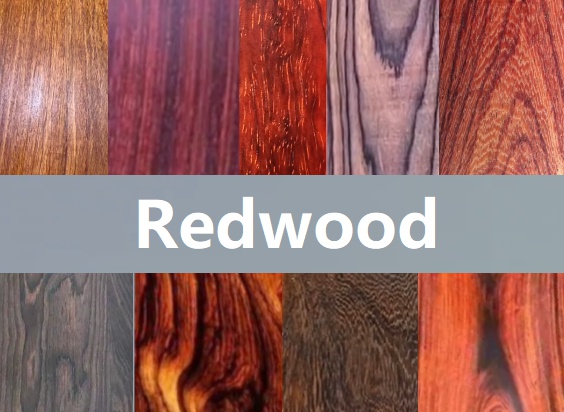
The English terms “Redwood”, “Mahogany”, “Chinese Mahogany” and “Rosewood” are often used loosely in trade and marketing, sometimes overlapping with the Chinese concept of “红木”. From a technical and professional perspective, these names refer to very different botanical groups and wood products, each with specific properties, standards and applications. This guide systematically clarifies these names, their true meanings and their practical implications for design, manufacturing and use.
Key Differences Among Redwood, Mahogany, Chinese Mahogany and Rosewood
In English wood terminology, “redwood”, “mahogany”, “Chinese mahogany” and “rosewood” are not synonyms; they represent distinct families or trade groups:
- Redwood: generally softwood from Sequoia or Sequoiadendron, used for construction and outdoor applications.
- Mahogany: classic tropical hardwoods, mainly Swietenia and some Khaya and related genera, used in furniture and joinery.
- Chinese Mahogany: usually Toona sinensis or related Toona species, a regional hardwood with its own characteristics.
- Rosewood: dense, often dark-colored tropical hardwoods from several genera (especially Dalbergia), partly corresponding to some “红木” categories in Chinese standards.
Confusion arises because in marketing, many red-toned woods or imported hardwoods are casually labeled as “redwood” or “mahogany”, and in Chinese the word “红木” covers a narrower, legally defined group of precious hardwoods that only partially overlaps with what is called “rosewood” in English.
About the Chinese Concept of “红木”
In Chinese context, “红木” is a standardized legal and technical term. It does not mean “any red-colored wood”, and it does not directly correspond one-to-one to any single English name such as “mahogany” or “rosewood”.
Definition and Scope of “红木”
Modern Chinese standards define “红木” based on botanical species, wood density and structural features, and classify them into several categories. Only timbers meeting the specified criteria are allowed to be labeled and traded as “红木”. These standards are used widely in furniture, flooring and cultural artifacts.
Many species commonly called “rosewood” in English belong to these “红木” categories, but not all. Similarly, some timbers marketed as “mahogany” in English markets are not “红木” according to Chinese standards. Therefore, professional evaluation always starts from species-level identification rather than color or trade names.
Relation Between “红木” and English Trade Names
The relationship between “红木” and English trade names can be summarized as follows:
- Some “红木” species are often translated as “rosewood” (e.g., several Dalbergia species).
- Some may be translated as “padauk”, “blackwood”, “ebony” or other trade names.
- “Mahogany” in English usually refers to Swietenia or Khaya, which generally do not fall under the strict “红木” categories.
- “Redwood” in English almost never denotes “红木”; it refers to coniferous softwood species from North America.
When working between Chinese and international standards, precise botanical naming is crucial to avoid mislabeling, regulatory issues and mismatched performance expectations.
What “Redwood” Means in English-Speaking Markets
In Western markets, “redwood” primarily refers to the softwood obtained from the coastal redwood (Sequoia sempervirens) and the giant sequoia (Sequoiadendron giganteum). There are also other regional uses of the term for different species, but coastal redwood is the dominant meaning.
Botanical Background and Trade Context
Coastal redwood is a very large coniferous tree native to the coastal areas of northern California and southern Oregon. It is managed under strict forestry regulations. The lumber is classified as softwood, even though it has good durability for outdoor use compared with many other softwoods.
Main Physical and Mechanical Properties of Redwood
Properties can vary with growth conditions and grade, but typical values for coastal redwood are:
- Basic density: about 380–450 kg/m³ (air-dry).
- Janka hardness: roughly 420–480 lbf (about 1,900–2,100 N).
- Modulus of elasticity (MOE): approximately 8–11 GPa.
- Dimensional stability: relatively good, moderate shrinkage from green to oven-dry.
- Natural durability: heartwood has good resistance to decay and insects; sapwood is less durable.
The wood is light reddish to brownish, with clear growth rings, straight grain and a relatively soft texture compared with hardwoods like rosewood or mahogany.
Common Uses and Limitations of Redwood
Redwood is widely used for:
- Decking, cladding and exterior siding.
- Outdoor furniture, pergolas, fences and garden structures.
- Rough construction, beams and posts in suitable regions.
- Interior paneling where a warm reddish tone is desired.
It is not appropriate to equate redwood with “红木” or with dense tropical hardwoods in high-load structural furniture applications. Its softness, although workable and pleasant for tools, limits its suitability for high-wear surfaces like heavy-use flooring compared with harder species.
Mahogany: Classic Tropical Hardwood Group
Mahogany is a long-established trade name for several tropical hardwoods used in furniture, joinery and boatbuilding. The term can refer to genuine mahogany in the genus Swietenia, African mahoganies (mainly Khaya) and other woods that share some appearance and working properties.
Genuine Mahogany (Swietenia spp.)
Genuine or “true” mahogany usually refers to species like Swietenia macrophylla, Swietenia mahagoni and Swietenia humilis, originating from Central and South America and the Caribbean.
Typical properties include:
- Density: about 500–650 kg/m³ (air-dry), depending on species and origin.
- Janka hardness: roughly 800–1,100 lbf (about 3,500–4,900 N).
- MOE: around 9–12 GPa.
- Grain: usually straight to interlocked, with moderate to high luster.
- Color: from pale pinkish-brown to deep reddish-brown, darkening with age.
Genuine mahogany is known for its workability, stability and fine finish. It machines well, holds details, glues and finishes reliably and has relatively low movement in service. These characteristics make it a benchmark species for premium furniture and joinery.
African Mahoganies and Other Mahogany-Type Woods
In commercial practice, “mahogany” may also refer to several African genera, especially Khaya, and sometimes Entandrophragma, among others. These are not botanically identical to Swietenia but share similar applications.
Common characteristics of many African mahoganies include:
- Density: typically 550–750 kg/m³ (air-dry).
- Janka hardness: around 900–1,500 lbf (about 4,000–6,700 N).
- Grain: interlocked grain is common, which can cause tear-out in machining.
- Color: pinkish to reddish-brown, often with ribbon-like figure on quartered surfaces.
Because many different species are marketed under the broad label “mahogany”, technical users must rely on documentation, certification and physical inspection to determine suitability for specific uses, especially in load-bearing or moisture-sensitive situations.
Common Applications and Selection Considerations for Mahogany
Mahogany is widely used in:
- High-end furniture frames, panels, doors and decorative moldings.
- Interior joinery and cabinetry requiring dimensional stability.
- Veneers for paneling, doors and furniture surfaces.
- Musical instruments, where tonal and stability characteristics are important.
- Boat and yacht interiors, with some species used in exterior brightwork when adequately protected.
When selecting mahogany, users should consider density, grain pattern, machining behavior and proven durability for the intended environment. Not every wood sold as “mahogany” will meet high-end performance expectations.
Chinese Mahogany: Toona Species and Their Role
“Chinese Mahogany” commonly refers to Toona sinensis and related species in the genus Toona. These trees are native to East and Southeast Asia and are valued both for timber and, in some regions, for edible shoots and ornamental planting.
Botanical Identity and Regional Use
Toona sinensis is a deciduous tree reaching medium to large size. The wood is classified as hardwood. In some English-language materials it may be called “Chinese mahogany” due to its reddish color and certain similarities to other mahogany-type woods, but it is botanically distinct from Swietenia or Khaya.
In Chinese markets, the timber is sometimes used in mid-range furniture, interior finishing and other general-purpose applications. It is not part of the strict “红木” categories defined in Chinese standards.
Physical and Mechanical Properties of Chinese Mahogany
Values can vary with site conditions and growth rate, but typical ranges for Toona sinensis are:
- Density: approximately 450–600 kg/m³ (air-dry).
- Janka hardness: typically 700–1,000 lbf (about 3,100–4,400 N).
- Grain: usually straight or slightly interlocked, with a fine to medium texture.
- Color: light to medium reddish-brown, sometimes with subtle figure.
- Stability: moderate dimensional movement; adequate if properly dried and conditioned.
The wood is workable by both hand and machine tools, though like many hardwoods, care with sharp tools and proper machining parameters is required to manage grain direction and minimize tear-out.
Typical Uses and Practical Considerations
Chinese mahogany is used for:
- Mid-range furniture, bed frames and cabinet components.
- Interior doors, frames, decorative paneling and moldings.
- Small crafts, carved items and decorative objects.
The wood does not typically match the density or hardness of many rosewoods or certain high-density “红木” species. Therefore, for heavy-duty flooring, surfaces subject to intense abrasion or structural components needing very high strength, alternative species may be preferred.
Rosewood: Dense Tropical Hardwoods in the Trade
“Rosewood” is a trade name applied to several dense, often richly colored hardwoods, especially within the genus Dalbergia. These woods are known for their high density, distinctive color patterns and use in fine furniture, musical instruments and decorative objects.
Dalbergia Rosewoods and Related Species
Many classic rosewoods belong to the genus Dalbergia. These species occur in different regions including Asia, South America and Africa. The heartwood color ranges from purplish-brown and dark brown with black streaks to red or orange-brown, often with dramatic stripes or variegated figure.
Typical characteristics of many rosewoods include:
- Density: often 800–1,100 kg/m³ (air-dry), sometimes higher.
- Janka hardness: commonly 2,000–3,000 lbf (about 8,900–13,300 N) or more, depending on species.
- Texture: fine to very fine, with a natural oily or waxy feel in some species.
- Stability: generally good when properly dried, though high density can require careful drying schedules.
- Heartwood durability: typically very high resistance to decay and insect damage.
Some non-Dalbergia species are also marketed as rosewood due to similar appearance and high density. From a technical standpoint, precise identification is essential for regulatory compliance and for predicting machining behavior, gluing performance and finishing outcomes.
Rosewood in Relation to Chinese “红木”
Several rosewood species are included in Chinese “红木” classifications. These species are widely used in high-end classical furniture, carved pieces and cultural artifacts.
Important alignment points include:
- Many “rosewood” species in international trade have direct counterparts within the “红木” categories.
- However, the English term “rosewood” is not limited to Chinese “红木” species, and some timbers labeled as rosewood elsewhere may not match Chinese standards.
- In the Chinese market, labeling a product as “红木” carries specific technical and regulatory implications, while in English markets “rosewood” often focuses on appearance and perceived quality.
This difference has practical consequences for import/export documentation, customs classification and consumer expectations.
Applications and Technical Considerations for Rosewood
Rosewoods are used for:
- High-end furniture frames, carved panels and structural components.
- Turnery, inlays, veneers and fine decorative work.
- Musical instruments, such as fingerboards, bridges and backs and sides of acoustic instruments, where density and acoustic properties are important.
- Flooring and stair treads for environments demanding very high wear resistance.
Due to their high density and sometimes oily nature, rosewoods can present technical challenges:
- Machining requires sharp, wear-resistant tools and appropriate feed rates.
- Gluing may require surface preparation and carefully selected adhesives compatible with oily woods.
- Finishing demands attention to extractives that can affect coating adhesion and color stability.
Proper processing and handling are essential to realize the full potential of rosewoods in demanding applications.
Comparative Overview of Redwood, Mahogany, Chinese Mahogany and Rosewood
To assist in distinguishing these woods in practical selection and specification, the following table summarizes key technical aspects. Values are typical ranges; actual properties vary by species, site, growth conditions and processing.
| Property | Redwood | Mahogany (general) | Chinese Mahogany | Rosewood (general) |
|---|---|---|---|---|
| Botanical type | Softwood (conifer, mainly Sequoia) | Hardwood (mainly Swietenia, Khaya) | Hardwood (Toona sinensis and related) | Hardwood (mainly Dalbergia and related) |
| Typical air-dry density | ~380–450 kg/m³ | ~500–750 kg/m³ | ~450–600 kg/m³ | ~800–1,100 kg/m³ |
| Typical Janka hardness | ~420–480 lbf | ~800–1,500 lbf | ~700–1,000 lbf | ~2,000–3,000 lbf or higher |
| Common color range | Light red to reddish-brown | Pale to deep reddish-brown | Light to medium reddish-brown | Dark brown to purplish or reddish with streaks |
| Durability of heartwood | Moderate to good | Moderate to good (varies by species) | Moderate | Generally high |
| Typical applications | Decking, siding, outdoor structures | Furniture, joinery, veneers, interiors | Furniture, interiors, general joinery | High-end furniture, instruments, fine joinery, flooring |
| Relation to Chinese “红木” | Not “红木” | Generally not “红木” | Not “红木” | Some species are included in “红木” categories |
Trade Names, Misuse and Labeling Issues
In practice, many trade names are used flexibly. This flexibility can create several issues and complications for manufacturers, distributors and end users when working with red-toned or imported hardwoods.
Common Sources of Confusion in Naming
Several recurring patterns in mislabeling and misunderstanding can be identified:
- Any reddish timber marketed as “redwood”, even when botanically unrelated to true redwood.
- Multiple tropical hardwoods labeled “mahogany” based on appearance rather than species.
- Various dense hardwoods advertised as “rosewood” although they are not Dalbergia and do not meet certain standards.
- Products in Chinese markets labeled as “红木” without meeting the legally defined species and property requirements.
From a technical and legal standpoint, these practices risk causing discrepancies between expected and actual performance, as well as compliance issues where species-specific regulations apply.
Issues Affecting Buyers and Users
When trade names are used imprecisely, several practical issues can arise:
- Mismatched mechanical performance: furniture or flooring built from incorrectly assumed species may not meet load-bearing, wear or dimensional stability requirements.
- Processing difficulties: machining, gluing and finishing parameters optimized for one group (e.g., mahogany) may not be suitable for another (e.g., rosewood).
- Pricing discrepancies: paying premium prices for lower-performance substitutes when names are used mainly for marketing appeal.
- Compliance and documentation: incomplete or incorrect species information complicates certification, customs clearance and project documentation.
Therefore, professional users need to go beyond trade names and evaluate wood products using species information, standardized technical data and credible laboratory or certification reports.
Identification and Verification of Wood Species
Given the possibility of mislabeling, reliable identification is important. For technical projects, relying only on color or simple visual cues is insufficient. A structured approach uses multiple sources of evidence.
Macroscopic and Microscopic Characteristics
Physical inspection can provide preliminary identification clues:
- Growth ring appearance, pore distribution and parenchyma patterns in hardwoods.
- Resin canals and tracheid structure in softwoods like redwood.
- Color, luster and dullness variations between heartwood and sapwood.
- Presence of characteristic odors when freshly cut or machined.
Microscopic examination of thin sections can reveal diagnostic features of vessels, fibers and rays, enabling more precise identification. Laboratory methods often combine microscopy with reference atlases and databases.
Density, Hardness and Mechanical Testing
Measured density and hardness values can help distinguish between groups such as redwood, mahogany, Chinese mahogany and rosewood. For instance:
- A relatively low-density, soft wood with coniferous structure is unlikely to be rosewood or mahogany.
- Extremely high density and hardness strongly indicate species in or near the rosewood group or other high-density hardwoods, not typical redwood or Chinese mahogany.
Standardized tests, such as those in widely recognized norms, provide reference ranges for each species. Comparing measured values with known ranges improves confidence in identification.
Documentation, Certification and Expert Evaluation
For commercial shipments and major projects, documentation and independent verification are important. Practices include:
- Obtaining scientific names (genus and species) on invoices, packing lists and specifications.
- Requesting technical data sheets from suppliers, including density, hardness and other properties.
- Using accredited laboratories for wood species identification where high assurance is required.
- Engaging qualified wood technologists or experts for complex high-value applications.
Combining these measures helps ensure that wood labeled as “redwood”, “mahogany”, “Chinese mahogany” or “rosewood” actually corresponds to the expected technical characteristics and performance in use.
Application-Specific Considerations for Wood Selection
Choosing between redwood, mahogany, Chinese mahogany and rosewood depends on the demands of the application, including mechanical loads, wear, environmental conditions and finishing requirements. A structured comparison supports rational selection.
| Application | Redwood | Mahogany | Chinese Mahogany | Rosewood |
|---|---|---|---|---|
| Outdoor decking & structures | Suitable (with appropriate design and treatment) | Generally for protected areas; some species may be used with finishing | Occasional use in protected exterior locations | Technically durable but often reserved for high-value uses rather than large outdoor structures |
| Indoor furniture | Used for less demanding items, not common for high-end pieces | Well-suited for a wide range of furniture styles and price levels | Suitable for mid-range furniture and general interior joinery | Preferred for high-end, heavily carved or prestigious furniture |
| Flooring | Limited by softness; not ideal for high-traffic areas | Usable in moderate-traffic residential settings | Usable for moderate loads with correct design | Highly suitable for high-traffic areas requiring very high wear resistance |
| Musical instruments | Used occasionally for non-critical components | Common for necks, backs and sides of certain instruments | Less common; sometimes for regional instruments | Widely used for fingerboards, bridges and high-end instrument components |
| Decorative veneers & paneling | Used where a light red tone is sufficient | Extensively used in architectural and furniture veneers | Used in regional markets for decorative panels | Reserved for high-value veneers and decorative elements |
Practical Guidance for Professionals and Buyers
When confronted with offers of “redwood”, “mahogany”, “Chinese mahogany” or “rosewood”, a consistent evaluation process helps align selection with technical and performance needs. The following points summarize practical guidance.
Clarify Species and Origin
Request the botanical name and geographic origin for each wood product. This allows cross-referencing with technical databases and standards, and avoids relying solely on ambiguous trade names. Where multiple species are mixed within one trade name, understanding the range of possibilities helps gauge risk and performance variability.
Match Properties to Application Requirements
Define key performance needs in terms of density, hardness, dimensional stability, durability and machining/finishing behavior. Compare these requirements with known ranges for candidate species. For example:
- For high-wear flooring, prioritize high-density, high-hardness woods such as many rosewoods, rather than softwood redwood.
- For interior joinery and furniture requiring stable machining and finishing, quality mahogany offers a balanced solution.
- For cost-sensitive projects where moderate density and general versatility suffice, Chinese mahogany may be appropriate.
Verify Quality and Conditioning
Regardless of species, correct drying, storage and processing are critical for performance. Consider:
- Moisture content limits appropriate to the end-use environment.
- Absence of internal stresses, checks, severe warp or case-hardening.
- Consistency of color and grain for visible surfaces.
Working with suppliers that provide consistent quality and clear technical information reduces the risk of dimensional movement, surface defects and finishing problems during service life.
Conclusion
Redwood, mahogany, Chinese mahogany and rosewood represent four distinct groups of woods, each with its own botanical foundation, physical and mechanical properties and practical applications. The Chinese concept of “红木” overlaps mainly with certain rosewood categories and does not equate directly with any single English trade name.
By distinguishing softwood redwood from tropical hardwood groups, separating genuine mahogany from broader “mahogany-type” woods, recognizing Chinese mahogany as a specific regional hardwood and understanding the high-density, high-performance role of rosewoods, professionals and buyers can make more accurate, technically sound decisions. Precise species identification, clear documentation and property-based selection are the core tools for aligning wood names with actual performance in use.