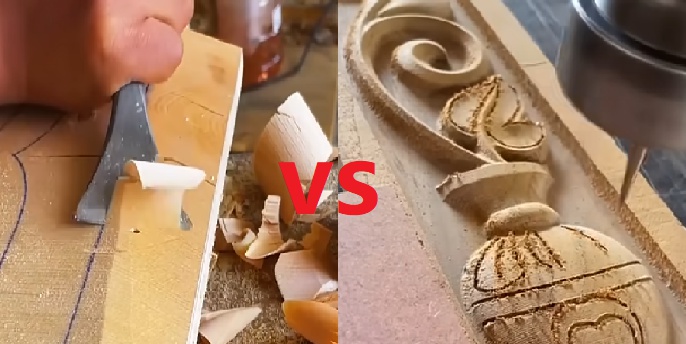
Overview of Manual and CNC Wood Machining
Wood machining is the process of removing material from solid wood panels, boards, or engineered wood products to create components with specific dimensions, shapes, and surface qualities. The two primary approaches are manual wood machining and CNC (Computer Numerical Control) wood machining.
Manual wood machining relies on a skilled operator physically guiding tools and machines. CNC wood machining uses computer-controlled motion based on digital programs to cut, drill, and shape workpieces. Both methods are widely used in furniture production, cabinetry, architectural millwork, musical instruments, and general woodworking, but they differ significantly in equipment, workflow, accuracy, labor requirements, and suitability for different production volumes.
Fundamental Principles of Manual Wood Machining
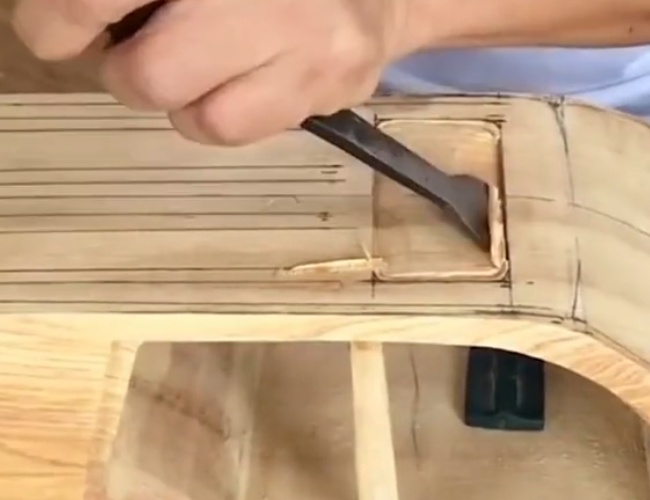
Manual wood machining refers to operations performed using hand-held power tools and manually operated machines where the operator controls feed direction, speed, and positioning. The cutting tool path is determined in real time by the operator’s movements and adjustments.
Common characteristics include:
- Direct human control of the tool or workpiece
- Continuous dependence on operator skill and attention
- Setup based on physical stops, fences, jigs, and marking-out
The removal of material follows basic cutting principles: the cutting edge engages the wood fibers at specific rake and clearance angles; chip formation and surface quality depend on tool sharpness, cutting speed, grain direction, and machine stability.
Fundamental Principles of CNC Wood Machining
CNC wood machining uses automated motion control systems. A computer sends commands to motors and drives that move the cutting tool (or workpiece) along defined axes. The path, depth, and speed of cutting are described by a digital toolpath file generated by CAM (Computer-Aided Manufacturing) software.
Key characteristics of CNC machining include:
- Pre-programmed, repeatable motion along multiple axes (commonly X, Y, Z)
- Separation of design (CAD), toolpath generation (CAM), and execution (CNC control)
- Capability to perform complex, multi-step operations in one automated cycle
The basic cutting physics are the same as in manual machining, but the control of feed rates, spindle speeds, and tool paths can be more precise and consistent, allowing tighter dimensional control and repeatability.
Key Equipment in Manual Wood Machining
Manual wood machining equipment ranges from portable power tools to stationary machines with mechanical adjustments. Typical machines include:
Table saw: Used for ripping and crosscutting boards and panels. Fence and miter gauge adjustments are performed manually. Operator pushes the workpiece through the blade.
Jointer and planer: Used for flattening, straightening, and thicknessing boards. The operator adjusts infeed and outfeed tables and feeds the workpiece manually.
Shaper or router table: Uses rotary cutters for profiling edges and forming joints. Fence and depth of cut are manually set, and the operator guides the workpiece along the fence.
Band saw: Used for curved cuts and resawing. The operator manually tracks the cutting line, guiding the workpiece against the blade.
Drill press: Provides perpendicular holes and repetitive drilling with mechanical depth stops and fence systems.
Hand-held power tools: Routers, circular saws, jigsaws, sanders, and drills are guided directly by the operator, often using templates or jigs for consistency.
These machines depend on mechanical settings (scales, knobs, stops) and visual references rather than digital positioning systems.
Key Equipment in CNC Wood Machining
CNC wood machining equipment integrates mechanical structures with electronic control and software. Common CNC machines for wood include:
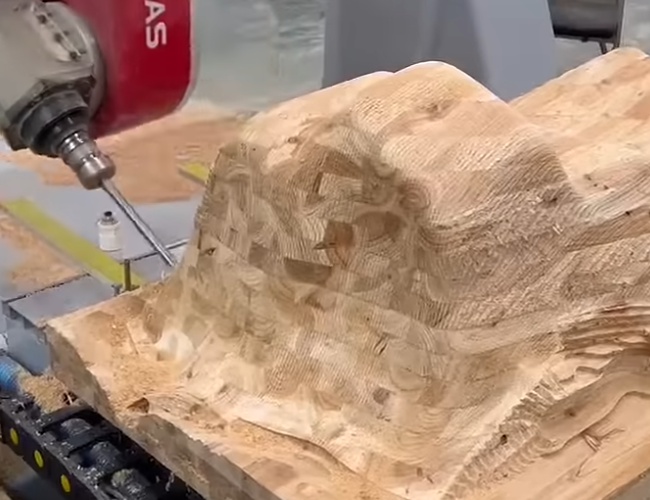
CNC router: The most prevalent CNC machine for wood. A rotating router spindle moves along X, Y, and Z axes to perform cutting, drilling, pocketing, and profiling. Workpieces are fixed on a bed using vacuum pods, vacuum tables, or mechanical clamps.
CNC machining center: More advanced systems with automatic tool changers, multiple spindles, and integrated drilling heads. They support high-speed production of cabinet parts, furniture frames, and panel components.
CNC nesting machine: Designed for optimizing panel cutting and processing. It performs cutting, drilling, and grooving on full sheets based on nesting patterns generated by software, minimizing waste.
CNC lathe or turning center for wood: Used for spindles, columns, and turned parts. The workpiece rotates while fixed tools move under CNC control to produce precise profiles.
CNC equipment typically includes:
- Motion axes driven by stepper or servo motors
- Ball screws or rack-and-pinion drives
- Linear guides
- Electronic control unit with CNC interface
- Dedicated CAM or nesting software
Workflow: Manual vs CNC Wood Machining
The workflows differ substantially in how work is prepared and executed.
In manual machining, the sequence is usually:
Design or drawing → Material selection and cut list → Marking-out and layout → Machine setup using mechanical adjustments → Manual machining operations (cutting, drilling, shaping) → Inspection and hand fitting → Assembly.
In CNC machining, a common sequence is:
Digital design (CAD) → Toolpath generation (CAM or nesting software) → Material preparation and fixturing → CNC program setup (tool selection, offsets, zero points) → Automatic machining cycle → Measurement and verification → Assembly.
Manual workflows rely heavily on physical layout marks, jigs, and operator decisions at each stage. CNC workflows shift the decisions into the digital preparation phase, with execution being largely automated once the program is validated and the workpiece is loaded.
Technical Precision and Accuracy Comparison
Precision and accuracy are critical in joinery, fit of components, and repeatability across many parts. Manual and CNC machining deliver different capabilities in this area.
In manual machining, dimensional variation is influenced by operator consistency, material handling, and machine condition. Tolerances of ±0.5 mm are common in typical furniture work, though skilled operators can achieve tighter tolerances for individual pieces, especially with careful fitting and hand tools.
CNC machines can hold tighter tolerances, especially in stable environmental conditions and with proper calibration. Typical woodworking CNC routers can achieve positional accuracy on the order of ±0.1–0.2 mm across the working area, depending on machine design and maintenance. Repeatability across hundreds of parts is usually much more consistent than with manual handling.
However, wood remains a variable material. Moisture content changes can cause dimensional movement that may exceed the machine’s theoretical accuracy. Therefore, both manual and CNC machining must account for wood movement in joint design and part sizing.
Repeatability, Consistency, and Part Matching
Repeatability refers to the ability to produce multiple parts with the same dimensions and features. Manual machining can reach an acceptable level of repeatability with fixtures, templates, and gauges, but small deviations accumulate. Minor differences in feed pressure, alignment to fences, and visual reference can lead to dimensional drift.
CNC machining, once a validated program is in place, repeats the same toolpath exactly for each part. This reduces the risk of variation in hole spacing, mortise locations, and complex contours. It also simplifies assembly because parts are more uniform, which is particularly important in batch production of cabinet components, panelized furniture, and modular architectural elements.
Productivity and Throughput Considerations
Productivity includes cycle time per part, changeover time between tasks, and the degree of operator involvement during machining. Manual machining is flexible for one-off tasks and irregular work but demands continuous attention. Cycle times depend on operator speed and efficiency.
CNC machining can significantly increase throughput for repeated parts. Once fixturing and programs are established, a CNC router can cut a full panel of cabinet parts, including shelf holes, dadoes, and cutouts, in a single cycle without operator intervention beyond loading and unloading. This concentrates effort in setup and programming, while execution becomes faster and more predictable.
For very small quantities or unique workpieces, programming time may offset any speed advantage, making manual methods comparable or even faster. For medium to large production runs, CNC systems typically provide higher parts-per-hour output.
Labor Skill Requirements and Training
Manual wood machining requires hands-on skills: tool setup, reading and transferring measurements, controlling feed rate, recognizing sounds and vibrations, and making adjustments based on visual and tactile feedback. Mastery often requires extensive practice and experience.
CNC machining shifts the skill emphasis to digital competencies. Operators and programmers must understand CAD and CAM software, coordinate systems, toolpaths, and machine parameters. They need to manage tool libraries, offsets, and program revisions. Physical machining skills are still required for fixturing, tool changes, and basic machine maintenance, but precision is less dependent on hand-guided motion.
Shops must decide whether to prioritize manual craft skills, digital manufacturing skills, or a combination. Both types of skills remain important, especially where manual work is used for prototyping or finishing alongside CNC production.
Cost Structure: Investment, Operation, and Maintenance
The cost profile of manual versus CNC machining is different across initial investment, operating costs, and ongoing maintenance.
| Cost Factor | Manual Wood Machining | CNC Wood Machining |
|---|---|---|
| Initial machine investment | Relatively low per machine; multiple specialized machines often needed. | Higher upfront cost; single machine can perform many operations. |
| Floor space | Distributed across several machines; flexible layout. | Concentrated in one or a few large machines; requires clear access. |
| Labor cost per part | Higher due to continuous manual involvement. | Lower for repeated work as machines run automatically. |
| Programming / setup | Minimal digital work; physical setups and jigs required. | Requires CAD/CAM programming and digital setup, especially for new parts. |
| Maintenance | Mechanical tune-ups, bearings, tool sharpening. | Mechanical plus electronic and control system maintenance. |
| Consumables | Cutters, blades, sanding materials; replacement due to operator misuse more likely. | Cutters, collets, vacuum seals; consumption more predictable with controlled cutting parameters. |
Decision-making on equipment purchases often weighs initial capital cost against longer-term savings in labor and improved throughput and consistency.
Tooling, Cutting Parameters, and Process Control
Both manual and CNC machining use similar types of cutting tools: router bits, saw blades, drills, and cutters designed for wood. However, the control and optimization of cutting parameters differ.
In manual machining, feed rate is determined by how fast the operator pushes the workpiece or moves the tool. Visual and auditory feedback is used to avoid burning, tear-out, and tool overload. Spindle speeds may be adjustable in steps or continuously via controls on the machine.
In CNC machining, spindle speed and feed rate are programmed numerically. Feed per tooth and chip load can be calculated and applied more consistently. This allows better control of:
- Cutting forces
- Heat generation
- Tool life
- Surface finish
For example, a CNC program can define a feed rate of 8–12 m/min for panel cutting with a specific tool and spindle speed, while manual feeding may vary significantly around that target. Multiple passes at precise depths can be programmed to reduce load on the tool and spindle, improving cut quality and tool lifespan.
Surface Quality and Edge Finishing
Surface quality is influenced by tool geometry, sharpness, feed rate, spindle speed, and machine stability. Manual machines can produce high-quality surfaces in the hands of trained operators, especially when combined with hand sanding or scraping.
CNC machines typically provide consistent edges and surfaces, especially with sharp cutters and correct feeds and speeds. Complex contours and 3D surfaces can be machined with overlapping toolpaths and small step-over distances to achieve fine finishes that require minimal sanding.
However, edge quality in both methods is affected by wood species, grain direction, and presence of knots. End grain cutting and cross-grain routing may still require additional sanding or secondary operations. Climb cutting can reduce tear-out but requires secure fixturing; CNC machines can apply controlled climb cutting more safely and consistently than manual routing in many cases.
Complex Geometry and 3D Wood Machining Capability
Manual machining handles straight lines, basic curves, and joinery efficiently using standard tools and jigs. More complex shapes are usually created with a combination of bandsaw work, templates, hand routing, and extensive hand shaping and sanding.
CNC machining is highly suitable for complex 2.5D and 3D geometries. With multi-axis motion, a CNC router can produce:
Relief carvings, curved panel surfaces, freeform chair components, geometric patterns, and precise recesses for hardware, in a repeatable way. Tools such as ball-nose end mills and tapered ball-nose cutters, combined with high-resolution toolpaths, can produce detailed surfaces across large workpieces.
For intricate components that must be replicated many times, CNC methods provide a more systematic approach than manual shaping and carving, which depend heavily on individual craftsmanship.
Production Volume and Batch Size Considerations
Production volume is a central factor when deciding between manual and CNC machining approaches. Manual methods are often suitable for:
Prototypes, one-off custom pieces, repair and restoration work, and small batches where each piece may differ. The absence of programming overhead makes manual machining efficient for isolated, highly individualized tasks.
CNC machining becomes more advantageous as the number of identical or similar parts increases. Once the CAD model and CAM program exist, the cost per part declines with each additional unit produced. CNC nesting of panels allows efficient production of large numbers of cabinet parts or flat components with minimal manual measurement or layout.
Shops that produce both custom and standard items may combine approaches, using manual methods for very small runs and CNC systems for recurring or modular components.
Material Handling, Workholding, and Fixturing
Secure and accurate workholding is essential to achieve consistent results. In manual wood machining, workpieces are typically handled directly by the operator, pressing them against fences, tables, and stops. For complex shapes or repeated operations, hand-made jigs and templates are widely used.
In CNC machining, fixturing must prevent movement under cutting forces while allowing the tool to reach all required areas. Common methods include:
Vacuum tables for full-sheet processing, vacuum pods for point support with clearance for edge machining, mechanical clamps, T-track systems, and dedicated fixtures for irregular shapes. Fixturing must align the workpiece accurately to the machine’s coordinate system; zero points and reference edges are defined in the control software.
Effective fixturing improves accuracy, reduces vibration and tool wear, and protects against workpiece displacement, which can degrade surface quality or damage tools.
Quality Control and Inspection Methods
Quality control in wood machining involves dimensional checks, visual inspection of surfaces and edges, and verification of assembly fit. In manual machining, inspection is commonly performed with tape measures, calipers, squares, and gauges at the machine and during dry assembly. Operators adjust as needed, sometimes modifying jigs or cut dimensions to correct for deviations on the spot.
In CNC machining, measurements and verification occur both during setup and after production. Tools include digital calipers, height gauges, dial indicators, and test cuts to verify tool offsets and program correctness. Some operations use probing routines to locate workpiece edges or surfaces and compensate for minor misalignment.
Because CNC machining is highly repeatable, errors are often systematic: a wrong offset or program parameter can affect many parts identically. This makes initial validation and sample inspection critical before running full batches. Once validated, ongoing spot checks ensure that wear, tool changes, or environmental factors have not introduced variation.
Safety Aspects in Manual and CNC Wood Machining
Wood machining involves rotating cutters, flying chips, dust generation, and the risk of kickback or workpiece ejection. Manual machining exposes the operator more directly to moving parts. Hands are close to the cutting zone, and manual feeding creates the potential for kickback, especially on table saws and shapers.
CNC machines typically enclose moving components within guards and require doors or covers to be closed during operation. The operator is usually outside the cutting area during active machining. Nevertheless, safe operating procedures are essential: proper clamping, correct tool installation, and adherence to machine interlocks and emergency stops. Dust extraction systems and hearing protection are important for both manual and CNC environments.
Automation reduces direct exposure but introduces the need for safe program validation, as incorrect toolpaths can lead to collisions between tools, fixtures, and machine structures if not properly checked.
Integration with CAD/CAM and Digital Design
CNC machining is closely integrated with digital design tools. Components are modeled in CAD software, with precise dimensions, joint geometries, and hardware locations defined numerically. CAM software then converts these models into optimized toolpaths, including cutting sequences, drilling operations, and engraving.
This digital chain allows consistent transfer of design data to the machine without manual transcription, reducing errors and enabling fast modifications. Design changes can be implemented by editing the model and regenerating toolpaths rather than reconfiguring physical jigs and fixtures.
Manual machining can also benefit from CAD drawings, but translation from drawing to machine setup remains a manual operation. Dimensions are read from the drawing and applied to fences, stops, and depth settings by the operator, which is more prone to misreading or misalignment.
Application Scenarios Best Suited to Manual Machining
Manual wood machining remains well suited to specific scenarios where flexibility and direct control are more valuable than automation. Typical applications include:
Restoration work, where existing pieces are irregular and may require gradual adjustment and fitting. One-of-a-kind, highly customized furniture where shapes and proportions may be refined directly on the workpiece. On-site modifications or installations, where portable tools are needed. Initial proof-of-concept prototypes, where design is evolving rapidly and programming would be premature.
In these situations, the ability to adapt continuously to the material, design changes, and unforeseen conditions often outweighs the benefits of CNC repeatability.
Application Scenarios Best Suited to CNC Machining
CNC wood machining is particularly effective in environments where repeatability, complexity, and digital integration are important. Typical applications include:
Batch production of cabinet components, including nested-panel cutting and automated drilling for hardware. Production of modular furniture systems with standardized parts and hole patterns. Manufacturing of complex 3D components such as ergonomic chair parts or decorative panels. Efficient utilization of panels through nesting to reduce material waste.
These operations benefit from the consistent dimensional accuracy, reduced manual handling, and streamlined design-to-production workflow that CNC systems offer.
Comparative Summary of Manual vs CNC Wood Machining
The differences between manual and CNC wood machining can be summarized based on practical criteria used in workshops and manufacturing environments.
| Criterion | Manual Wood Machining | CNC Wood Machining |
|---|---|---|
| Control method | Direct human control of tool or workpiece | Computer-controlled tool motion via digital programs |
| Setup approach | Mechanical stops, fences, jigs, visual layout marks | Digital coordinates, toolpaths, offsets, and fixtures |
| Precision and repeatability | Dependent on operator skill and consistency | High repeatability once program and setup are validated |
| Suitability by volume | Effective for one-offs and very small batches | Effective for medium to large batches and recurring parts |
| Complex shapes | Requires extensive templates and manual shaping | Handles intricate 2D/3D forms with precise toolpaths |
| Labor requirements | High manual involvement during cutting | More involvement in programming and setup, less during cutting |
| Initial equipment cost | Lower; multiple machines may be required | Higher; one machine can perform many operations |
| Changeover between tasks | Physical reconfiguration and jig adjustments | Program and setup changes; rapid for pre-existing jobs |
| Design integration | Uses drawings but relies on manual interpretation | Direct link from CAD model to toolpaths and machine |
| Operator proximity to tools | Hands close to cutting area; direct exposure | Operator typically outside enclosed cutting zone |
Choosing Between Manual and CNC Wood Machining
Selecting the appropriate machining method involves evaluating the nature of the work, available skills, budget, and production goals. Manual wood machining offers flexibility and direct control, making it suitable for unique pieces, adjustments on the fly, and situations where individual craftsmanship is central to the process.
CNC wood machining offers controlled, repeatable, and efficient production when supported by accurate digital design and programming. It introduces a systematic workflow from CAD to finished components, delivering consistent dimensions and surface quality across large numbers of parts.
Many operations combine both approaches, using CNC systems for precise, repetitive components and manual methods for fitting, assembly, and finishing. By understanding the strengths and constraints of each method, it is possible to configure a wood machining process that aligns with the specific technical requirements, cost targets, and quality expectations of each project.