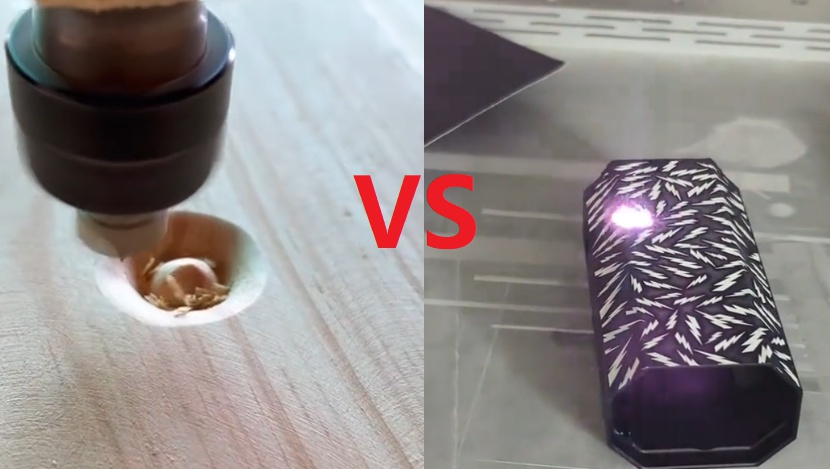
CNC engraving and laser engraving are two widely used methods for permanently marking, decorating, or machining parts and products. They differ fundamentally in their working principles, machine configuration, compatible materials, achievable precision, operating costs, and typical applications. This guide provides a systematic and technical comparison to support process selection for industrial, commercial, and workshop environments.
Fundamental Working Principles
The main difference between CNC engraving and laser engraving lies in how material is removed or modified.
Subtractive Mechanical Cutting (CNC Engraving)
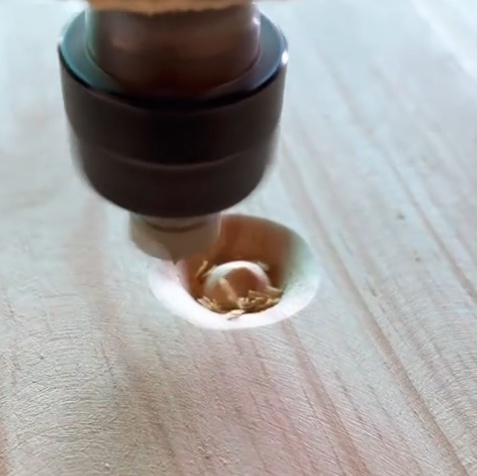
CNC engraving is a subtractive machining process. A rotating cutting tool removes material along programmed toolpaths.
- A spindle drives an end mill, engraving bit, or V-bit at set speed (rpm).
- Linear axes (usually X, Y, Z) are driven by stepper or servo motors.
- Material is cut by mechanical contact; chips are produced.
- Cut depth is controlled via Z-axis position and feed per pass.
Toolpath commands are typically based on G-code, generated from CAD/CAM software. The machine controller interprets G-code lines for movements, spindle speed, and other functions.
Non-Contact Thermal Material Removal (Laser Engraving)
Laser engraving uses a focused laser beam to heat and vaporize or chemically change the material surface.
- A laser source (CO₂, fiber, or diode) emits a beam with specific wavelength and power.
- Optics (lenses, mirrors, or galvanometer scanners) focus and steer the beam.
- Material is removed or marked by melting, vaporization, ablation, or surface discoloration.
- Depth is controlled via power, speed, number of passes, and focus position.
Laser systems may use gantry motion (mechanical XY movement) or high‑speed galvo heads (moving mirrors). Control software translates graphics or CAD data into scanning paths and laser pulses.
Machine Components and System Configuration
CNC Engraving Machine Architecture
A typical CNC engraving system consists of:
- Rigid frame and base for stiffness and vibration control
- Linear motion components (guide rails, ball screws, rack and pinion, or belt drives)
- Spindle motor (air‑cooled or water‑cooled) with collet system
- Tool holders and engraving bits with specific geometries
- Workholding devices (vises, clamps, vacuum tables, T‑slot tables)
- Motion controller and drives (stepper or servo, with feedback in some systems)
- Coolant or air blast for chip evacuation and tool life
Machine rigidity, spindle power, and motion accuracy determine achievable surface quality and feature size.
Laser Engraving System Architecture
A laser engraving system typically includes:
- Laser source (CO₂ tube, fiber laser module, or solid-state diode)
- Beam delivery system (mirrors, lenses, focusing head)
- Motion subsystem (gantry rails and belts, or galvanometer scanner)
- Worktable or conveyor for material positioning
- Exhaust and filtration system for fumes and particulates
- Cooling unit (chiller for CO₂, integrated cooling for many fiber systems)
- Control software for raster and vector engraving
Laser type and wavelength strongly influence which materials can be processed and the resulting engraving contrast.
Material Compatibility
Both technologies can engrave a wide range of materials, but with different strengths and constraints.
Materials Suited to CNC Engraving
CNC engraving is broadly compatible with:
- Metals: aluminum, brass, copper, steel, stainless steel, titanium (with appropriate tooling and parameters)
- Plastics: acrylic, ABS, PVC (with proper chip extraction), polycarbonate, POM, HDPE
- Wood and wood composites: hardwoods, softwoods, MDF, plywood
- Composites: fiberglass, some carbon fiber laminates (dust extraction required)
- Others: wax, foam, some ceramics (with suitable tooling and feeds)
Because it is contact-based, CNC engraving can machine materials with high reflectivity or transparency that may be problematic for some laser wavelengths.
Materials Suited to Laser Engraving
Material compatibility depends on laser type:
1) CO₂ Laser (Commonly 10.6 µm)
Well-absorbed by organic and many non-metallic materials:
- Wood, paper, cardboard, leather
- Acrylic and many plastics (not all types behave the same under heat)
- Glass and certain ceramics (often surface marking or frosting)
- Rubber for stamps and gaskets
- Painted or coated metals (coating is removed; base metal usually not engraved without additional processes)
2) Fiber Laser (Commonly 1064 nm)
Well-suited for metals and some technical plastics:
- Stainless steel, carbon steel, tool steel
- Aluminum and its alloys
- Brass, copper, titanium and other alloys (with proper settings)
- Certain engineering plastics with suitable absorption at the wavelength
Transparent materials at this wavelength (e.g., clear glass, most transparent plastics) are generally not engraved efficiently by standard fiber lasers.
Engraving Quality, Precision, and Tolerances
Dimensional Accuracy
CNC engraving accuracy depends on mechanical system quality:
- Well‑built machines can achieve positional accuracy in the range of ±0.01–0.05 mm.
- Backlash, spindle runout, and tool deflection affect small features.
- Proper setup and calibration are critical for precision work.
Laser engraving accuracy depends on optical and motion subsystems:
- Gantry laser systems typically reach positional accuracy around ±0.05–0.1 mm.
- Galvo systems can achieve very fine spot positioning with small field sizes.
- Spot size and thermal diffusion limit minimum line width and spacing.
Detail Resolution
Detail resolution for CNC engraving is limited by tool diameter, tool geometry, and machine stiffness. Very fine tools (e.g., 0.1–0.2 mm tip) can create small features but are fragile and require low feed rates.
Laser engraving resolution is limited by spot size and motion control. A typical laser spot may range from approximately 50–300 µm depending on optics and lens focal length. Higher resolution is achievable with smaller spots and optimized optics.
Surface Finish Characteristics
CNC engraving surface finish is influenced by:
- Tool sharpness and coating
- Spindle speed and feed rate
- Depth of cut and step-over
- Material machinability
Proper parameter selection can yield clean, well-defined edges with machining marks aligned with toolpath directions.
Laser engraving surface characteristics result from heat interaction:
- Some materials show crisp, high‑contrast marks (e.g., anodized aluminum, coated metals).
- Wood can exhibit darkened edges or charring depending on power and speed.
- Plastics may melt, bubble, or show color change depending on formulation.
- Glass often shows a frosted, micro-fractured surface where engraved.
Control of power, speed, frequency, and focus allows tuning of contrast and depth within the constraints of the material.
Depth Control and 3D Capability
Depth in CNC Engraving
CNC engraving offers direct control over depth via Z‑axis movement:
- Depth per pass is defined in CAM; multiple passes achieve deeper cuts.
- Accurate engraving of varying depths is possible for 2.5D effects.
- Full 3D reliefs are achievable with appropriate 3D toolpaths and ball nose cutters.
- Depth repeatability relies on machine rigidity and tool length offset calibration.
Depth in Laser Engraving
Laser engraving depth is controlled by energy input:
- Higher power, slower speed, and multiple passes increase depth.
- Certain materials allow deep engraving (e.g., some metals and plastics), while others are limited to shallow marks or surface coloration.
- Focusing above or below the surface modifies energy density and edge profile.
- Extended depth engraving may require careful management of debris or melt ejection.
True 3D engraving or relief with lasers is possible on some materials using grayscale maps and multiple passes, but it is generally more constrained than mechanical 3D machining in harder materials.
Throughput, Speed, and Productivity
Processing Strategy Differences
CNC engraving often uses vector toolpaths that follow curves or lines. Toolpaths can be optimized for minimal travel and efficient passes but are constrained by feed rates required to preserve tool life and surface quality.
Laser engraving can operate in two modes:
- Vector engraving: the beam follows vector lines similar to CNC toolpaths.
- Raster engraving: the beam scans line by line (similar to printing) for filling areas and images.
Raster mode is especially efficient for large filled regions or graphics, while vector mode is used for outlines and text.
Relative Speed Considerations
Laser systems can achieve very high scanning speeds, especially with galvo heads, which improves productivity for surface marking, logos, and fine text. CNC engraving typically has lower linear speeds due to mechanical inertia and tool constraints, particularly in metals or deep cuts.
However, for deep material removal and structural features, CNC engraving can be more practical because mechanical cutting can remove substantial material more efficiently than ablation at typical laser powers.
Cost Factors and Maintenance
Initial Investment
Cost ranges vary based on power, size, and build quality. The following table provides a generalized comparison for small to medium systems used for engraving applications.
| Aspect | CNC Engraving Machine | Laser Engraving Machine |
|---|---|---|
| Typical entry-level price range | Lower for hobby-class routers; higher for precision metal-capable units | Low to medium for small diode and CO₂ desktop units; higher for industrial fiber or high-power CO₂ |
| Floor space | Generally larger footprint relative to work area | Compact units available; industrial systems vary |
| Key wear components | Cutting tools, spindle bearings, linear guides, ball screws or belts | Laser tube or source, optics (lenses, mirrors), motion components |
| Tooling or consumables | Engraving bits, end mills, coolant or lubricants | Protective lenses, filters, sometimes assist gas |
| Operator skill requirements | Knowledge of feeds, speeds, tool selection, and workholding | Knowledge of laser parameters, focus setting, and material response |
Operating and Maintenance Costs
CNC engraving costs include:
- Tool replacement based on wear and breakage
- Lubrication and periodic maintenance of mechanical components
- Possible coolant expenditure and waste disposal depending on process
- Electricity for spindle, motion drives, and auxiliary systems
Laser engraving costs include:
- Laser source replacement after its rated operating life (especially CO₂ tubes)
- Regular cleaning and occasional replacement of lenses and mirrors
- Exhaust and filtration system maintenance (filters, ducting)
- Electricity for laser source, motion, and cooling
Safety and Environmental Considerations
Safety in CNC Engraving
Key aspects include:
- Mechanical hazards from moving parts and rotating tools
- Risk of flying chips; eye and skin protection are required
- Noise from spindle and cutting processes
- Dust and chip management via extraction systems
Machine enclosures and interlocks can reduce exposure to moving parts and debris. Proper personal protective equipment (PPE) and training are essential.
Safety in Laser Engraving
Laser systems introduce additional hazards:
- Eye and skin hazards from direct and reflected laser radiation
- Generation of fumes, vapors, and fine particulates that must be extracted and filtered
- Risk of material ignition, especially with flammable substrates
- Potential for invisible beams (especially infrared wavelengths), requiring appropriate shielding
Enclosed laser systems with interlocks and certified viewing windows are commonly used to meet safety requirements. Ventilation and filtration are critical for maintaining air quality.
Typical Applications and Use Cases
Applications of CNC Engraving
CNC engraving is often selected for:
- Metal part identification (serial numbers, codes, labels) where deep, durable marks are required
- Mold cavity text and logo engraving
- Signmaking in metals, plastics, and wood with precise depth control
- Mechanical panels, instrument faces, and control plates
- 3D relief engraving in wood, plastics, and soft metals
It is especially suitable where structural strength and deeper cuts are needed, or where the material is difficult for certain laser wavelengths.
Applications of Laser Engraving
Laser engraving is widely used for:
- High-speed marking of metal components (especially with fiber lasers)
- Engraving logos, text, and images on promotional products
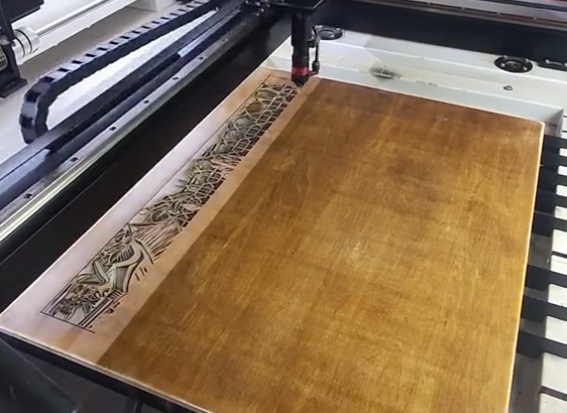
- Engraving photos and fine graphics on wood, acrylic, and coated metals
- Barcode, QR code, and data matrix marking for traceability
- Surface marking on sensitive parts where minimal mechanical stress is required
Laser engraving is particularly effective where non-contact processing, fast surface marking, or fine detail graphics are important.
Comparison by Technical Criteria
| Criterion | CNC Engraving | Laser Engraving |
|---|---|---|
| Material removal method | Mechanical cutting with rotating tool | Thermal ablation or surface modification |
| Contact with workpiece | Direct contact; requires secure fixturing | Non-contact; workholding may be simpler |
| Depth control | Direct Z‑axis control; suitable for deep cuts | Controlled via power, speed, and passes; depth depends on material |
| Minimum feature size | Limited by tool diameter and stiffness | Limited by spot size and thermal effects |
| 3D capability | Strong; full 2.5D and 3D machining possible | More limited; best suited to shallow relief and surface marking |
| Force on part | Significant cutting forces; can deform thin parts | Minimal mechanical force; suitable for delicate parts |
| Surface effects | Machining marks; controlled via tools and strategy | Heat-affected zones, discoloration, or frosting depending on material |
| Noise and chips | Produces chips and usually higher noise levels | Produces fumes and particulates; less mechanical noise |
| Setup complexity | Tool selection, workholding, zeroing, parameter tuning | Focus adjustment, parameter tuning, and artwork positioning |
| Maintenance focus | Mechanical components and tool wear | Optics, laser source, and exhaust system |
Selection Considerations for Specific Requirements
Choosing Based on Material and Product Requirements
Material type often determines the appropriate technology. Metals requiring deep, durable engraving or structural modifications commonly favor CNC engraving, especially where cutting is needed in addition to marking. For high-volume, shallow marking on metals or detailed graphics on organic materials, laser engraving offers speed and precise surface control.
Choosing Based on Detail and Graphics
Laser engraving is generally more suitable for fine graphics, images, and complex shading on flat surfaces. CNC engraving is preferred for sharp, V‑cut text, chamfered edges, and features with specific profile geometries.
Choosing Based on Production Environment
In environments where non-contact processing, minimal mechanical stress, and consistent shallow marking are essential, laser engraving is often favored. When a process must both engrave and perform other machining operations, or when deep cuts in robust materials are required, CNC engraving is usually more appropriate.
In many operations, both technologies are used in combination: CNC for structural machining and depth-critical features, and laser engraving for high-speed markings, serial numbers, and fine graphics.
Practical Pain Points and Constraints
Common Issues in CNC Engraving
Typical challenges include:
- Tool breakage when using very fine cutters or incorrect feeds and speeds
- Vibration or chatter affecting small text and fine details
- Fixturing difficulties with thin or flexible parts
- Longer cycle times for detailed surface patterns or large filled areas
Common Issues in Laser Engraving
Typical challenges include:
- Color or contrast variability on some materials due to formulation differences
- Charring or melting on wood and plastics if parameters are not optimized
- Fume and particulate management requiring effective extraction and filtration
- Limitations engraving highly reflective or transparent materials at certain wavelengths
Summary
CNC engraving and laser engraving are complementary technologies with distinct technical characteristics. CNC engraving relies on mechanical cutting, offering precise depth control and the ability to machine a broad range of materials, including those that are reflective or transparent to certain laser wavelengths. It is well-suited for deeper cuts, structural features, and applications requiring robust mechanical performance.
Laser engraving employs focused light to modify or remove material without direct contact. It delivers high-speed, high-detail surface marking, particularly effective on metals with fiber lasers and on organic or polymer materials with CO₂ lasers. It is often preferred where minimal mechanical load on the workpiece and fine graphic reproduction are priorities.
Process selection should be based on material type, required engraving depth, detail level, production volume, and integration with other manufacturing steps. Understanding the technical attributes of both methods enables informed decisions and efficient deployment in industrial, commercial, and workshop contexts.